Showing posts with label marketside by Walmart. Show all posts

Thursday, September 23, 2010

Revisting 'marketside by Walmart': Format As We Know it On the Way Out But Some or All Of the Four Stores Could Be Converted

News & Analysis

In this September 9, 2010 piece - Walmart Plans to Close Arizona 'marketside by Walmart' Stores, Dump Format By Year-End or Early 2011 - we reported that Walmart Stores, Inc. will end its small-format 'marketside by Walmart' format and close the four stores in Arizona, either by the end of this year or in early 2011, and discussed and offered analysis on the issue. The stores and format were called 'marketside' until the retailer added "by Walmart' to the name in 2009.

Since we reported and published the piece, we've learned about some additional thinking and discussion at Walmart, involving the four 'marketside by Walmart' stores, which range in size from a little over 15,000 square-feet to about 18,000 square-feet.

Although the 'marketside' fresh food and grocery format as we know it now is going away, Walmart is considering not closing some or all of the four stores, and instead converting them to one or more different formats.

Here's what we know right now:

Even though the 'marketside by Walmart' stores are smaller than Walmart's 20,000 square-foot 'Neighborhood Market by Walmart' prototype store in Rogers, Arkansas [See our July 6, 2010 story - July 6, 2010: Walmart Looking for Store Sites in Northern California For 20,000 Sq-Ft Neighborhood Market by Walmart Prototype Store], Walmart Stores' is considering converting some or all four of the 'marketside' stores, which are in Gilbert, Chandler, Mesa and Tempe, Arizona, into a slightly scaled-down version of the 20,000 square-foot 'Neighborhood Market by Walmart' format and store. Based on what we know today, this is the most likely option of the three we're laying out in this piece.

Second, Walmart could replace one or more of the 'marketside by Walmart' units with a smaller version (a true bodega) of its 'Supermercado de Walmart' Latino format stores.

Walmart has a couple of these stores in Metro Phoenix. However, the stores are in renovated Walmart Neighborhood Market stores that, like this one in Phoenix, are 39,000-42,000 square-feet. All four of the 'marketside by Walmart' stores are less than half that size, which is why it would have to be a smaller, hybrid version the the current 'Supermercado de Walmart' units open and operating in Arizona.

Walmart has been working on such a smaller format though. It also operates such stores - in the 15,000 square-foot range, and even smaller - in Mexico. So it wouldn't be a stretch at all. The demographics, however, are only decent for a Hispanic format store in two of the four cities/neighborhoods where the 'marketside' stores are located. Therefore, it would only make sense to convert one, and maybe two, of the 'marketside by Walmart' stores into a Latino consumer-focused store, as described above.

Lastly, Walmart could put a new, "corner grocery store" (our term) type of format it's been working on into one or more of the four 'marketside by Walmart' stores in Arizona. Think of it as an "American" bodega. Walmart first started developing this format, both Latino and non-Latino consumer-focused versions, two years ago. Read our report: September 29, 2008: Special Report: Wal-Mart, Inc. Studying Second Small-Format Food and Grocery Store Concept; the 'Bodega' or Modern Version of the Corner Grocery Store.

What we know about this format is that it's more focused on basic groceries than Walmart's 'marketside' format is, less upscale and, although it offers some prepared foods, isn't fresh-prepared foods-focused like the 'marketside by Walmart' format is.

We don't know conclusively at this point in time what Walmart is going to do with the four Arizona 'marketside by Walmart' stores. But, based on our most recent information, our analysis is it's likely the retailer will retain at least two, and perhaps all four of the stores, converting the format. A key reason - but far from the only reason - for this is because Walmart Stores, Inc. has long-term leases on the four buildings the stores are housed in.

Further, it's our analysis, based on what we know today, the most-likely format to replace 'marketside' in one or all of the four Arizona 'marketside by Walmart' stores, is a slightly scaled-down, smaller version of the 20,000 square-foot 'Neighborhood Market by Walmart' format.

For example, the 20,000 square-foot prototype store in Rogers, Arkansas includes a pharmacy and fairly good-sized in-store deli. These two departments could be reduced in size, along with shrinking the overall footprint of the 20,000 square-foot store a bit, and then dense up the core of the store, and the format as it is, with just the changes described above, could easily fit in the four 'marketside by Walmart' boxes (the stores.)

Walmart should announce the fate of the format and the four stores at its upcoming analysts meeting in October. We're further reporting the story, and will probably have something additional before then. Stay tuned.

Also, read our December 21, 2009 story: Wither Walmart's Small-Format 'marketside' Stores and Format? And our January 9, 2010 piece - Walmart's 'marketside': What's 'In-Store' for 2010? They offer a good, integrated road map to the present.

Thursday, September 9, 2010

Walmart Plans to Close Arizona 'marketside by Walmart' Stores, Dump Format By Year-End or Early 2011

The History - and End - of Walmart's 'marketside by Walmart' Format and Stores in Five Acts

Act 1: The beginning

We've been watching, reporting on and analyzing Walmart Stores, Inc.'s 'marketside by Walmart' (originally called just 'marketside') four-store chain of small-format food and grocery stores since before the stores were opened in four cities in Metropolitan Phoenix, Arizona in October 2008, nearly two years ago. [Read a selection of our stories here. Click the 'newer posts' link at the bottom of the linked page for additional stories.]

Act 2: The beginning of the end

On December 21, 2009, we reported in this piece - Wither Walmart's Small-Format 'marketside' Stores and Format? - that Walmart Stores, Inc. had eliminated its Web Site for the four then 'marketside' (now named 'marketside by Walmart') small-format grocery and fresh foods markets and replaced it with a single Web Page introducing the company's new line of 'marketside' store brand food products, which are named after the fresh foods-focused format stores in Arizona.

As you can see in the piece linked above, we further suggested in the story that 'marketside by Walmart's' days were numbered.

Act 3: The curtain is closing

On January 9, we followed up our December 21, 2009 piece with a story titled: Walmart's 'marketside': What's 'In-Store' for 2010? At the end of the piece we offered three predictions about the 'marketside by Walmart' format and stores and its 'Marketside' brand, which Walmart is using on packaged fresh-prepared foods, pre-packaged fresh produce, fresh salsas, packaged breads and baked goods, along with using to brand some of its supercenter deli departments.

Below (in italics) is the prediction we made in the story regarding the 'marketside by Walmart' format and stores. It just happens to be prediction number one:

Walmart will keep the four Arizona 'marketside by Walmart' stores open in 2010. It will do so in part to serve the research and development function we mention above. Walmart won't open any new small-format 'marketside by Walmart' stores in 2010 though, either in Arizona or elsewhere in the U.S.

So far - nine months into 2010 - our prediction is correct. Walmart hasn't opened any additional 'marketside by walmart' stores this year, nor has it closed the four Metro Phoenix, Arizona stores...yet.

Act 4: Enter the replacement format

In early July of this year, we published this story - July 6, 2010: Walmart Looking for Store Sites in Northern California For 20,000 Sq-Ft Neighborhood Market by Walmart Prototype Store - in which we not only broke the news Walmart Stores, Inc. is looking for sights in Northern California for the 20,000 or so square-foot 'Neighborhood Market by Walmart' format and grocery store its been experimenting with in Rogers, Arkansas, but also said, based on information we obtained, that Walmart would eventually be closing the four Arizona 'marketside by Walmart' stores, shelving the format, and replacing it (the format not that actual four stores) with a final version of the 'Neighborhood Market by Walmart' prototype store.

Here's what we said (in italics) in the July 6 story:

Walmart Stores, Inc. currently has no plans to open any additional Marketside by Walmart stores - anywhere - including in Northern California. In fact, the retailer still holds leases on two sites in Southern California, one in San Diego and another in nearby Oceanside, but has no plans to open them as Marketside by Walmart stores. Construction at both locations, vacant retail buildings, has never been started, nor are there any plans to do so in the near future.

It's our analysis that Walmart is likely to replace the Marketside by Walmart format with some final version of the 20,000 square-foot Neighborhood Market by Walmart prototype, in terms of not opening any additional Marketside stores, and eventually close the four stores in Arizona, or replace one or more with the 20,000 square-foot prototype. It's important to note that the 20,000 square-foot prototype store in Rogers, Arkansas remains a work in progress in terms of not being cast in stone as the final format product, just like the name Neighborhood Market by Walmart might not end up being what it's called.

Act 5: The End is Near

Walmart's small-format 'marketside by walmart' has gone from withering in December 2008, to beginning to die on the vine in early January 2010, to starting to show signs of rot a little over two months ago, in July 2010, according to our chronology of reporting.

And now, the end is coming very soon for the four 'marketside by walmart' stores and the format.

Based on information we've obtained, Walmart Stores, Inc. plans to announce the closing of the four Metro Phoenix 'marketside by Walmart' stores - which are located in the cities of Gilbert, Chandler, Mesa and Tempe - before the end of December 2010, and no later than in the first quarter of 2011.

Yes, Walmart's small-format, Tesco Fresh & Easy Neighborhood Market-like, fresh food and grocery-focused small-format experiment will soon come to an end.

Currently, based on our information (and as we said in our July 2010 story), the format replacement for 'marketside by walmart' is the 20,000 or so square-foot 'Neighborhood Market by Walmart' prototype store in Rogers, Arkansas. Walmart continues to tweak the format, by the way.

Additionally, Walmart will continue to remodel and build its larger (average 40,000 square-foot) Neighborhood Market supermarkets, a few of which have had name changes to 'Neighborhood Market by Walmart' on a selective basis thus far.

So there you have it. Walmart's four 'marketside by Walmart' stores, which all opened on October 4, 2008, will soon be history, along with the format. The history of Walmart's 'marketside by Walmart' in five acts, as reported on and analyzed by Fresh & Easy Buzz.

But, like the story of the mythical 'Phoenix' (appropriate since the four 'marketside by Walmart' stores happen to be in Metro Phoenix, Arizona) rising out of the ashes, not only has a brand name - 'marketside' - for fresh-prepared foods, pre-packaged produce, fresh salsas, and fresh-baked breads, rolls and a cookie, along with a brand name for store deli/prepared foods departments - been born out of the small-format stores, but so too has a new format - the 20,000 or so square-foot 'Neighborhood Market by Walmart' prototype, which is rising out of what will soon be the ashes of the 'marketside by Walmart' format and stores.

Walmart Introduces 'Marketside' Brand Packaged Fresh-Baked Breads, Sub Rolls and Chocolate Chunk Cookie


Breaking Buzz: Private Brand Showcase

Walmart Stores, Inc. has introduced its line of 'Marketside' brand pre-packaged fresh-baked breads and submarine sandwich-style rolls, along with the first item, a 3.17 ounce Chocolate Chunk Cookie, in what will be a multi-item companion line of 'Marketside' packaged, ready-to-eat fresh baked goods.

The first items in the 'Marketside' fresh-baked bread line are:

Bread Loaves, 16 ounce packages:

>Roasted Garlic Artisian Loaf
>MultiGrain Boule
>Neo Tuscan Boule
>Combo Loaf
>Ciabatti Loaf
>Seeded Rye Loaf
>MultiGrain Loaf Bread
>Sourdough Loaf Bread
>Pumpernickel Loaf Bread

Sub Sandwich-Style Rolls, 16 Ounce Packages

>Seeded Rye Sub Rolls
>Sourdough Sub Rolls
>MultiGrain Sub Rolls
>Pumpernickel Sub Rolls

As mentioned, the Chocolate Chunk Cookie (pictured below) is currently the only item in the 'Marketside' private brand fresh baked goods line. But there are more SKUs to come soon.
We said Walmart would be introducing the 'Marketside' breads and baked goods "soon" in this March 31, 2010 piece: Walmart Adds Additional Marketside Fresh Food Items to Marketside.com Not Long After Our February Reports. They retailer has done so.

The new fresh-baked bread, sub roll and baked goods lines join Walmart's other 'Marketside' store brand packaged food items - fresh-prepared foods, take-and-bake pizza's, packaged produce and salsa, giving Walmart Stores, Inc. 'Marketside' "fresh" items in three categories: Deli, produce and bakery. [Click here for a selection of past stories about Walmart's 'Marketside' brand items in the fresh-prepared foods and produce categories.]

The 'Marketside' items - and the categories they're in - are very similar in style, ingredient profile and packaging to what Tesco's Fresh & Easy Neighborhood Market has done with its fresh&easy brand, which it uses in all categories, including fresh-prepared foods/deli, and bakery.

Unlike Tesco's Fresh & Easy though, which is only able to sell the fresh&easy brand items in its 163 small-format stores in California, southern Nevada and Metro Phoenix, Arizona, Walmart is able to offer its 'Marketside' "fresh" items for sale in its thousands of supercenters (and some discount format stores) and Neighborhood Market supermarkets in the U.S., as well as in its four small-format 'marketside by Walmart' food and grocery stores in the suburban Phoenix, Arizona cities of Mesa, Tempe, Gilbert and Chandler.

Walmart is currently developing additional 'Marketside' brand items in the fresh-prepared foods, pre-packaged produce and fresh bread/baked goods categories.

The mega-retailer is also rolling out the 'Marketside' store brand items to additional stores, such as the many recent discount format stores its been converting to hybrid supercenters.

Tuesday, July 6, 2010

Walmart Looking for Store Sites in Northern California For 20,000 Sq-Ft Neighborhood Market by Walmart Prototype Store

Breaking News - Plus Analysis

Walmart Stores, Inc. is currently searching for numerous future store sites in Northern California, with a focus on existing vacant retail buildings, for its 20,000 square-foot Neighborhood Market by Walmart prototype format, which it's been testing in a store in Rogers, Arkansas near corporate headquarters in Bentonville for about a year, Fresh & Easy Buzz has learned.

In addition to its Northern California focus, Walmart is also scouting for sites for the smaller-format stores in northern Nevada, in other selected urban regions in the west, and at urban locations on the east coast and in the Midwest, particularly in Chicago, where it recently announced a major development initiative in partnership with the city and Mayor Richard Daley, in which Walmart will invest tens millions of dollars to develop numerous stores (multiple format, big and small) on Chicago's south and west sides.

The 20,000 square-foot prototype store in Rogers, Arkansas - which is essentially a smaller, hybrid version of Walmart's 40,000 square-foot Neighborhood Market format, mixed with some of the elements of its Marketside by Walmart fresh food and grocery format, four stores of which the retailer's been operating in Metropolitan Phoenix, Arizona since October 2008 - currently goes by the name Neighborhood Market by Walmart, as do at least two converted Neighborhood Market stores (both are 40,000 -to- 45,000 square-feet though); one in Naples, Florida and the other in Plano, Texas. However, according to our sources, Walmart has not yet decided if the 20,000 square-foot prototype will end up being called Neighborhood Market by Walmart, or if it will choose another name for it.

Walmart is searching for an initial 10 locations for the new concept, 20,000 square-foot Neighborhood Market by Walmart prototype format in the Sacramento Metropolitan region, and for about the same number of store sites in the San Francisco Bay Area, according to two Northern California-based commercial real estate sources in a position to know about the search.

According to our sources, Walmart is looking for at least three initial locations in Sacramento, with the other seven store sites being in the surrounding suburbs, including in Elk Grove, where Tesco's Fresh & Easy Neighborhood Market has two future store sites - one at Bruceville Road and El Grove Boulevard, and the other at Elk Grove Florin Road and Calvine Road. This mix is subject to adjustment and change.

Interestingly, Southern California-based Smart & Final is planning to open its first Henry's Farmers Market food and grocery store in Elk Grove in late August. [See here.]

Tesco's Fresh & Easy has had 19 publicly confirmed store locations in Northern California's Sacramento/Vacaville Metropolitan region since February 2008. Ten of the store sites are in Sacramento. The other seven are in the suburbs. Two of the stores are in Vacaville, which is about a 30 minute drive from Sacramento, and is located about mid-way between Sacramento and the Bay Area. [See - February 28, 2008: News & Analysis: Tesco's Fresh & Easy Confirms 19 Store Locations for the Sacramento-Vacaville Region in Northern California]

The search for store locations for the 20,000 square-foot prototype format, currently going by the name Neighborhood Market by Walmart, in the San Francisco Bay Area includes a mix of urban and suburban locations, including in the south Bay Area near San Jose, in the East Bay, as well as in San Francisco, and elsewhere in the nine-county region of about 7 million residents.

Tesco's Fresh & Easy has 18 confirmed future store locations in the San Francisco Bay Area. Those store sites were announced in February 2008 as well. Click here to read our most recent - and past - coverage on Fresh & Easy Neighborhood Market's plans in Northern California, including in the nine-county Bay Area.

Walmart is hoping to find some of the Northern California locations this year, and could announce, or at least confirm, its plans for the 20,000 square-foot stores before the year is out.

Fresh & Easy Buzz has visited the 20,000 square-foot new concept Neighborhood Market by Walmart store in Rogers, Arkansas. It differs from the traditional 40,000 square-foot Neighborhood Market format (about 152 existing stores at present) in a number of key ways, although its apparent to us it's where the inspiration and structural basis for the prototype comes from.

First, the 20,000 square-foot prototype store is more compact, but doesn't have a crowded look or feel to it. Second, the store's sight lines (lower but with fairly high-profile gondola shelving in order to hold plenty of SKUs) and overall interior design are an improvement over the traditional Neighborhood Market stores, in our analysis.

Additionally, the department graphics - green in color - in the 20,000 square-foot prototype store are colorful and pop when you set your eyes on them. The theme "Save Money Live Better," is used throughout the store.

The prototype store also features both full-service and self-service checkout lanes.

Lastly, the 20,000 square-foot prototype Neighborhood Market by Walmart store in Rogers, Arkansas has a service seafood counter, a deli/prepared foods department under the "Marketside" brand, am in-store cafe, and features a substantial offering of natural and organic food and non-food products, in addition to conventional national brands, and lots of private label SKUs, across all departments and categories.

We've been reporting and offering analysis for the nearly three-year existence of Fresh & Easy Buzz that in order for Walmart to have a significant presence in the food and grocery retailing space in Northern California it must have a multi-format and multi-square-foot strategy.

The retailer initially began exploring this strategy in late 2007/early 2008, when it located a number of potential sites in Northern California for its small-format (16,000 -to- 20,000 square-foot) Marketside by Walmart fresh food and grocery stores (originally named just Marketside). However, in 2009 Walmart put the opening of any new Marketside stores on hold, and began creating the 20,000 square-foot Neighborhood Market by Walmart prototype, the first and only store of its size currently being the one in Rogers, Arkansas.

There are currently four Marketside by Walmart stores in Metro Phoenix, Arizona. All four stores opened in early October 2008.

Walmart Stores, Inc. currently has no plans to open any additional Marketside by Walmart stores - anywhere - including in Northern California. In fact, the retailer still holds leases on two sites in Southern California, one in San Diego and another in nearby Oceanside, but has no plans to open them as Marketside by Walmart stores. Construction at both locations, vacant retail buildings, has never been started, nor are there any plans to do so in the near future.

It's our analysis that Walmart is likely to replace the Marketside by Walmart format with some final version of the 20,000 square-foot Neighborhood Market by Walmart prototype, in terms of not opening any additional Marketside stores, and eventually close the four stores in Arizona, or replace one or more with the 20,000 square-foot prototype. It's important to note that the 20,000 square-foot prototype store in Rogers, Arkansas remains a work in progress in terms of not being cast in stone as the final format product, just like the name Neighborhood Market by Walmart might not end up being what it's called. [For some background see - December 21, 2009: Wither Walmart's Small-Format 'marketside' Stores and Format? and January 9, 2010: Walmart's 'marketside': What's 'In-Store' for 2010?]

As we've reported and offered analysis on frequently in Fresh & Easy Buzz, Walmart has embarked on a strategy to increase its market share, which is minimal, in Northern California in three key ways.

First, it's converting as many of its Division I discount format stores - just as its doing throughout the U.S. - as it can in the region into hybrid supercenters, adding anywhere from 30,000 -to- 56,000 square-feet of additional space to the stores as part of a complete remodeling, and using that added space for fresh foods and groceries.

Additionally, following on the heels of the opening of its first-ever smaller-format, hybrid supercenter in Modesto, California in 2008, which is located in an about 90,000 (less selling space than that though) square-foot building, which formerly held a discount warehouse supermarket and a drug store, Walmart has been and is searching for similar sized - in the 75,000 -to- 1000,000 square-foot range - vacant big box stores in Northern California that it can remodel and turn into edited versions of its Supercenters, like it did with the Modesto store on McHenry Avenue in the city of 205,000, in Stanislaus County [See - May 6, 2010: Going Smaller & Getting 'Hybrid': Walmart's Smaller Supercenter in Vacant Retail Buildings Strategy Began in 2008]

Lastly, Walmart is proposing numerous new supercenters in Northern California, including in the Sacramento region - one is planned for Elk Grove in the southern part of town in fact - the Northern Central Valley (Stockton, Modesto, Merced regions), the Bay Area (in a limited way though because approval is difficult to get) and elsewhere.

The reason Walmart needs a multi-format and multi-square-footage strategy in Northern California is for two primary reasons: (a) obtaining approval for mega-supercenters is extremely difficult in the region (some cities and counties even have ordinances banning the big stores) and (b) the geographical (density) limitations in key cities like San Francisco, Oakland, San Jose, Sacramento and a couple others make locating and 100,000-plus square-foot supercenters (and even 75,000 square-foot units) nearly impossible. Therefore, focusing on a food and grocery- centric format like the 20,000 square-foot (or slightly bigger or smaller) Neighborhood Market by Walmart prototype is key for Walmart to become a grocery retailing player in the Northern California, as well as in numerous other similar places in the U.S., region.

Selected Related Stories from Fresh & Easy Buzz:

April 25, 2008: Going Smaller: Wal-Mart Might have Found A Solution or Two to Much of the Opposition to its Mega-Supercenter Stores in the USA

June 27, 2008: Wal Mart Has Created A New, More Upscale Supercenter Store Design Prototype; Submitting Plans For the Stores Selectively in U.S.

May 6, 2010: Going Smaller & Getting 'Hybrid': Walmart's Smaller Supercenter in Vacant Retail Buildings Strategy Began in 2008

September 15, 2008: Wal-Mart Expanding its Discount Store-to-Supercenter Conversion Program As Part of its Strategy to Grab Even More Food and Grocery Sales Market Share

November 19, 2008: Competitor News: Wal-Mart Lowering Prices on Holiday Items and Staples; New Formats Coming; Online Grocery Sales; Hundreds of New Stores FY 2009-2010

October 5, 2008: Wal-Mart's Marketside is More Than the Sum of the Parts of its Other Formats; While Time and Consumers Will Judge, We See the Format As A Stategic Fit

October 6, 2008: 'The Promotional Pundit:' How Wal-Mart Can Use its Supercenters to Create Customers For its New Small-Format Marketside Stores in Arizona

November 21, 2008: Breaking News: Wal-Mart Stores, Inc. Names New CEO to Replace Lee Scott; USA Chief Castro-Wright Elevated to Vice Chairman Effective Immediatly

February 11, 2009: Tesco's Fresh & Easy Isn't the Only Food & Grocery Retailer With its Eyes on Bakersfield: Wal-Mart's Bakersfield Push and Central Valley, CA Strategy

May 16, 2009: Competitor News: Wal-Mart Clears First Major Hurdle For Proposed Mega-Distribution Center in Merced, CA; Chain's Regional Strategy Moving Forward

October 3, 2008: Wal-Mart Opens First Four Small-Format Marketside Fresh Food and Grocery Stores Tomorrow Morning in Gilbert, Chandler, Mesa and Tempe, Arizona

December 21, 2009: Wither Walmart's Small-Format 'marketside' Stores and Format?

May 20, 2010: Welcome to Discountopia USA

Stories thus far in our on-going 2010 Northern California Market Special Report Series:

June 26, 2010: Tesco Planning to Announce in July When First Northern California Fresh & Easy Neighborhood Market Stores to Open

June 14, 2010: Newly-Named Whole Foods Market CO-CEO Walter Robb Comes Full Circle With the Opening of the New Store in Mill Valley CA

June 5, 2010: Sprouts Farmers Market Opens First Northern California Store in Sunnyvale; Strikes Up Partnership With Local Non-Profit Farm

May 29, 2010: Going Rural: Fresh & Easy Neighborhood Market to Build First Store in Los Banos, California

May 28, 2010: First Phase of Fresh & Easy Neighborhood Market-Anchored Condo Development in San Francisco's Bayview Set For Completion in June

April 19, 2010: Tesco Debating Whether to Launch Fresh & Easy Into Northern California This Fiscal Year... or Wait

May 9, 2010: A Whopping 15 of Whole Foods Market's 41 New Stores in Development are in California - And Nine of The 15 Are In Northern CA

May 8, 2010: Sprouts, and Likely Henry's to Beat Fresh & Easy to Northern California Despite it's Big Head Start

May 6, 2010: Going Smaller & Getting 'Hybrid': Walmart's Smaller Supercenter in Vacant Retail Buildings Strategy Began in 2008

[Readers: Click here and here to read about Fresh & Easy's Buzz's extensive reporting and analysis on Tesco's Fresh & Easy-Northern California, as well as on the Northern California market in general.]

Wednesday, March 31, 2010

Walmart Adds Additional Marketside Fresh Food Items to Marketside.com Not Long After Our February Reports

Walmart has now added its Marketside private brand fresh soups, which we reported on in February [Walmart Introducing New Ready-To-Heat Prepared Entrees, Fresh Soups Under its Marketside Brand], to its marketside.com Web site. There are eight varieties in the ready-to-heat soup line.

In addition, Walmart just-recently added its eight-item Marketside refrigerated take-and-bake pizza line (pictured at the top) to the site.

The pizzas were the very first item Walmart rolled out in its Marketside ready-to-heat and ready-to-eat, prepared foods line. It introduced the pizzas in selected stores in fall 2009. The refrigerated pizzas take about 17-19 minutes to bake at in a conventional oven.

Walmart has recently given the Marketside pizza package a makeover, giving it a new look, and bringing its graphic design in line with all of the other Marketside private brand prepared foods products introduced to date.

You can view the pizzas, soups and other items at the http://www.marketside.com/ site.

The reason the soup line have now been added to marketside.com is because Walmart has rolled the items out to many more of its Supercenters and Neighborhood Market supermarkets than was the case when we reported on the new Marketside store brand prepared foods items in February.

The pizzas were only recently added to marketside.com because of the packaging makeover mentioned above.

Next up for brand Marketside is a line of artisian breads and baked goods. Walmart is currently preparing to start introducing some of the items in selected stores soon, we've learned.

Additional varieties of Marketside fresh, prepared entrees and other ready-to-heat and ready-to-eat food items are also in the works, as we've previously elaborated on in a number of the posts linked below.

Walmart's Marketside: Recent Biography


Tuesday, March 9, 2010

Walmart Adds Two More SKUs to its Marketside Ready-To-Heat Fresh, Prepared Entree Line

Fresh, Prepared Foods Merchandising

Walmart Stores, Inc. has added two additional SKUs to its Marketside ready-to-heat, fresh prepared entree line, which Fresh & Easy Buzz was the first publication to report on that we're aware of.

The two additional fresh, prepared entree SKUs, sold in 3 pound family-style size packages, are: Lasagna With Meat Sauce (pictured at the top) and Chicken Enchiladas (pictured below). (We recall a similar Chicken Enchiladas entree - but not in the same packaging or same quality product - packed under the Sam's Club store brand, in the past.)
That makes four SKUs in the Marketside fresh, prepared entree line we've been able to document thus far: Mac N' Cheese With Bacon, Rigatoni With Italian Sausage; and now the Chicken Enchilada and Lasagna With Meat Sauce varieties.

Walmart has posted pictures of the two entree varieties on its marketside.com Web site. The two Marketside entree items we reported on in February (Mac N' Cheese With Bacon and Rigatoni With Italian sausage) weren't up on the site at the time. They are now, along with the Chicken Enchilada and Lasagna With Meat Sauce SKUs.

The marketside.com Web site also has some (but not all of the SKUs in the line) of the Marketside bagged and packaged fresh produce items we reported on in the February piece [Walmart Launching New Value-Added Pre-Packaged Fresh Produce Line Under its Marketside Fresh Foods Brand] pictured as well. All of the SKUs are listed in our story.

Further, the Marketside fresh soup line we reported on in this February 28, 2010 piece [Walmart Introducing New Ready-To-Heat Prepared Entrees, Fresh Soups Under its Marketside Brand] and the Marketside fresh salsa line we reported on in this March 2, 2010 post [Walmart Launching New 'Marketside Fresh Garden Salsa' Line Under its Fast-Growing Fresh Foods Store Brand] aren't depicted on marketside.com, perhaps because they're too new

There's also a "Bakery" tab on marketside.com. In case you're wondering when you see it, the tab is for a new line of Marketside fresh breads and baked goods the retailer will be introducing soon. Currently if you click the tab it says "Coming Soon." More to come on that "soon" in Fresh & Easy Buzz.

Fresh & Easy Buzz has been out front in reporting and writing about Walmart Stores, Inc.'s development of its new Marketside fresh foods store brand.

For example, see the posts linked below:

>January 9, 2010: Walmart's 'marketside': What's 'In-Store' for 2010?

>December 21, 2009: December 21, 2009 piece - Wither Walmart's Small-Format 'marketside' Stores and Format?

>Click here and here for a selection of additional 'marketside' past posts.

Tuesday, March 2, 2010

Walmart Launching New 'Marketside Fresh Garden Salsa' Line Under its Fast-Growing Fresh Foods Store Brand


Fresh, Prepared Foods Merchandising

In addition to the new Marketside fresh, ready-to-heat soup, prepared entree and value-added, pre-packaged fresh produce lines we reported on and wrote about in these to pieces on February 28 [Walmart Introducing New Ready-To-Heat Prepared Entrees, Fresh Soups Under its Marketside Brand and Walmart Launching New Value-Added Pre-Packaged Fresh Produce Line Under its Marketside Fresh Foods Brand], Walmart Stores, Inc. is spicing things up by launching a new line of Marketside store brand fresh salsa in seven varieties.

The product is called Marketside Fresh Garden Salsa.

The seven SKU's in the new line are: Mild, Medium and Hot; Chipotle Garlic; Sweet Onion; Mango Peach; and Black Bean & Corn

The salsa comes in 18 oz plastic tubs, as you can see in the photograph at the top. The hot variety is pictured above.

The packaging for the fresh salsa is the same as that of the 10 oz Marketside Mild Pico De Gallo Salsa item in our February 28 report.

Walmart is in the process of rolling out the new Marketside fresh salsa line to selected Supercenters and Neighborhood Market supermarkets in the U.S. We've been told the line also could be sold in Walmart's discount format stores.

The 18 oz Marketside Fresh Garden Salsa line - like its cousin the 10 oz Pico De Gallo, which in the full line comes in medium and hot varieties in addition to the mild - is targeted to be merchandised in the refrigerated sections in the produce departments in Walmart stores. We suspect it might find its way to the self-serve refrigerated deli sections in some stores as well.

The unit price point for the new Marketside 18 oz Fresh Garden Salsa is about $2.99, depending on the region where a store is in the U.S.

Walmart has posted the new Marketside value-added, packaged fresh produce line (plus the Pico De Gallo Salsa) and the Marketside family-sized entrees from our February 28 story on its fairly recently revamped http://www.marketside.com/ Web site.

However, as of today, the new Marketside Garden Fresh Salsa line - or the ready-to-heat soup line we reported on also on February 28 - isn't included or depicted on the marketside.com site.

Sunday, February 28, 2010

Walmart Launching New Value-Added Pre-Packaged Fresh Produce Line Under its Marketside Fresh Foods Brand


Fresh Foods Merchandising: Value-Added Produce Category

Walmart Stores, Inc. is introducing an extensive new line of value-added fresh, bagged and pre-packaged produce items under its Marketside fresh foods brand, Fresh & Easy Buzz has learned.
Thus far, the line includes 17 SKUs in the following categories: Fresh, bagged or pre-packaged spinach greens, salad mixes and lettuce, value-added fresh veggies, and a fresh salsa item.

All of the value-added fresh produce items come in either clear bags or plastic packages/tubs. Below are the 17 new Marketside value-added fresh produce items, detailed under the four categories we've created and grouped them under:


Spinach Greens

>Marketside Fresh Spinach, 10 oz
>Marketside Organic Baby Spinach, 10 oz
>Marketside Organic Baby Spinach, 5 oz


Microwave In-Bag Value-Added Veggies

>Marketside Broccoli Cauliflower, 12 oz
>Marketside Broccoli Florets, 12 oz
>Marketside Broccoli/Cauliflower/Carrots Vegetable Medley, 12 oz
>Marketside Snow Peas, 8 oz
>Marketside Sugar Snap Peas, 8 oz


Salad Mix, Salads & Lettuce

>Marketside Classic Iceberg Salad, 12 oz
>Marketside Classic Iceberg Salad, 24 oz
>Marketside Classic Iceberg Salad, 6 oz
>Marketside Shredded Iceberg Lettuce, 8 oz
>Marketside Broccoli Slaw, 12 oz
>Marketside Organic Herb Mix, 5 oz
>Marketside Organic Spring Mix, 10 oz
>Marketside Organic Spring Mix, 5 oz

Fresh Salsa Mix

>Marketside Mild Pico De Gallo, 10 oz

Five of the 17 bagged and pre-packaged fresh produce items are organic, as you can see in the above list.

Walmart is launching its new Marketside value-added, bagged and packaged fresh produce items in selected Supercenters and Neighborhood Market supermarkets.
Some of the 17 items have been sold at Walmart's four small-format 'marketside by Walmart' fresh food and grocery stores in Metropolitan Phoenix. Those stores opened in May 2008.

Earlier today we reported on and detailed that Walmart is introducing a new line of pre-packaged, ready-to-heat fresh, prepared entrees and soups under its Marketside store brand. [February 28, 2010 Walmart Introducing New Ready-To-Heat Prepared Entrees, Fresh Soups Under its Marketside Brand] The two new lines follow Walmart's introduction last year of its Marketside take-and-bake pizza line.

The extension of store brand Marketside to the new pre-packaged, value-added fresh produce line shows Walmart plans to use Marketside as a complete fresh foods store brand, including fresh produce - and other types of fresh foods - under the brand, along with the fresh, prepared foods line.

Interestingly, the new Marketside value-added fresh produce line includes not only the upscale, specialty items like the fancy and organic greens, but also more basic items like the iceberg lettuce and fresh vegetables.

For those who haven't thought Walmart isn't planning to exploit "Fresh," this new development, along with the Marketside fresh, prepared foods line extension, should offer a change of mind.

Additionally, Walmart will be rolling out additional fresh foods items under its Marketside store brand. Stay tuned.

Walmart Introducing New Ready-To-Heat Prepared Entrees, Fresh Soups Under its Marketside Brand

Fresh, Prepared Foods Merchandising

Walmart Stores, Inc. is adding additional fresh, prepared foods items to its Marketside fresh foods store brand, as we predicted it would in this January 9, 2010 piece: Walmart's 'marketside': What's 'In-Store' for 2010?

First, Walmart is introducing a new line of Marketside family-size, ready-to-heat prepared entrees. Fresh & Easy Buzz has located two items/SKUs in the new prepared entree line thus far: Marketside Macaroni & Cheese With Bacon, in a 3 pound package, and Baked Rigatoni with Italian Sausage, in a 46 ounce package. (The Rigatoni With Sausage entree is pictured above; the Mac and Cheese With Bacon is at the top.)


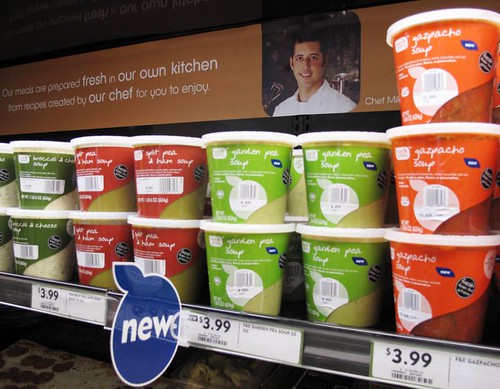
Additionally, Walmart has introduced a new line of ready-to-heat, refrigerated fresh soups (pictured above) under its Marketside brand.

The Marketside entrees and soups are similar to those marketed by Safeway (Signature Cafe store brand), Tesco's Fresh & Easy Neighborhood Market (fresh & easy brand) and a number of other U.S. food retailers. But the expansion by Walmart is significant from a competitive standpoint because the mega-retailer has thousands of U.S. stores in which it can sell the growing marketside fresh, prepared foods line

Walmart is in the process of launching the new Marketside fresh, prepared entree line and the fresh soup line in selected Supercenters and Neighborhood Market Supermarkets.

There will be additional items/varieties in the prepared entree line coming out soon, according to our sources and research.

The Marketside entrees and soups were originally created for Walmart's four small-format 'marketside by Walmart' fresh food and grocery stores located in the Metropolitan Phoenix, Arizona region, where the ready-to-heat fresh foods have been sold since the four stores opened in May 2008.

As we've reported and written about extensively, Walmart is using the 'marketside' stores as a laboratory for the development of its brand Marketside fresh foods program.

Walmart introduced its first Marketside branded fresh, prepared food item, a line of take-and-bake pizzas, to selected Supercenters and Neighborhood Market supermarkets last year. The pizzas were also developed at and are sold at the four Phoenix Metro region 'marketside by Walmart' stores.

Fresh & Easy Buzz reported in this December 21, 2009 piece - Wither Walmart's Small-Format 'marketside' Stores and Format? - that Walmart had replaced the Web site for its small-format 'marketside by Walmart' fresh food and grocery stores with a single page describing its new Marketside line of fresh foods.

We said this development signaled that Walmart was putting its primary emphasis regarding brand Marketside on the new fresh foods line rather than on additional 'marketside by Walmart' stores., which remains the case.

In our January 9, 2010 piece [Walmart's 'marketside': What's 'In-Store' for 2010?] we made three predictions about Walmart's brand Marketside for 2010.

One of those predictions was that Walmart would soon be rolling out additional fresh, prepared foods items under its Marketside store brand.

Here's what we said (in italics below) in prediction two of the three:

"Walmart will introduce a few additional packaged fresh, prepared foods items (SKUs) under its 'marketside' brand in some of its Supercenters, discount format stores and Neighborhood Market supermarkets in 2010, following up on the 'marketside' prepared, take-and-bake pizza.

Look for some or all of these prepared foods items in 2010: 'marketside' ready-to-heat fresh soups in containers and ready-to-eat packaged salads. Plus 'marketside' ready-to-heat prepared entrees in varieties like macaroni & cheese, meatloaf and pot roast, for starters."

Walmart is doing just what we predicted it would.

Walmart will be launching additional fresh, prepared - and other fresh foods - under its Marketside store brand this year.

Stay tuned.

[Click here and here for a selection of past posts in Fresh & Easy Buzz about Walmart's 'marketside' retail format and stores.]

[Editor's Note: In the past, Walmart used all lower-case letters for 'marketside.' It still uses lower-case for its 'marketside by Walmart' stores. However, Walmart is using Marketside (with a capital M) for its Marketside store brand. Therefore, we will follow this convention.]

Saturday, January 9, 2010

Walmart's 'marketside': What's 'In-Store' for 2010?

Analysis & Commentary

In December 2009 we published this piece [December 21, 2009: Wither Walmart's Small-Format 'marketside' Stores and Format?] in which we reported that the Web Site for Walmart Stores' 'marketside by Walmart' fresh food and grocery stores had been replaced by a single page site touting its new line of 'marketside' fresh, prepared foods, and examined the potential future of the four small-format stores, located in Metropolitan Phoenix, Arizona.

Our story has generated a considerable amount of interest in the food retailing industry and media, including being picked up by the convenience store industry trade publication CSP Reports on December 30, 2009 here and by CBS's BNET business news Web site on January 8, 2010 here.

Brand 'marketside' & synergy

In October 2008 we published this analysis and think piece [October 6, 2008: 'The Promotional Pundit:' How Wal-Mart Can Use its Supercenters to Create Customers For its New Small-Format Marketside Stores in Arizona] in which we suggested ways in which Walmart could use its retail power in the Arizona market to create a synergistic relationship for its start up 'marketside by Walmart' stores (then called just 'marketside'), as well as for all of its food and grocery retail formats and banners, particularly its flagship Supercenters and Neighborhood Market supermarkets.

Walmart operates Supercenters, club stores and its Neighborhood Market supermarkets in Arizona, along with the four 'marketside by Walmart' small-format food stores. Walmart is the food and grocery sales market share leader in Arizona., followed by Kroger's Fry's and Safeway Stores, Inc.

One thing we suggested in the October 2008 piece was that Walmart could open branded 'marketside' kiosks in its Supercenters. We also suggested various other things Walmart could do in this regard - the focal point being all about how the retailer could expand and extend 'brand marketside.'

Walmart in fact has recently started doing just that - extending its 'marketside' brand via a new line of store brand fresh, prepared foods products and branding 'marketside outside of the four walls of the small-format Arizona stores.

New 'marketside' fresh-prepared foods line

Recently Walmart began testing the sale of a new store/private label brand of fresh foods labeled 'marketside' in some of its Supercenters, discount format stores and Neighborhood Markets.

The first of the 'marketside' store brand fresh foods products are a line of prepared pizzas in varieties such as Three-Cheese, Pepperoni and Canadian Bacon. The retailer recently has been advertising the 'marketside' pizzas in its ad circulars and promoting them with price discounts in-store. Walmart handed out free samples of the 'marketside' pizza in many of its Supercenter and discount format stores during a special three day Thanksgiving holiday promotion in November.

Announcing the planned line of 'marketside' store brand fresh foods products in July 2009, Wal-Mart spokeswoman Amy Wyatt-Moore said in a statement: "We are testing a number of concepts on home meal replacements and chilled entrees under the 'marketside' brand in select Walmart stores."

Brand 'marketside' & Walmart's Neighborhood Markets

Walmart also started another 'marketside' branding experiment in late summer of 2009. It has rebranded the deli departments (including naming them 'marketside delis') in a handful of its Neighborhood Market supermarkets in Texas and Arizona as "marketside delis," also branding most of the bulk and packaged deli items and fresh, prepared foods under the 'marketside' brand, as it does in its four 'marketside by Walmart' food and grocery stores in Arizona.

Conceptually these two 'marketside' branding efforts outside of the four walls of the 'marketside by Walmart' stores reminds us much of what we suggested the retailer do vis-vis 'marketside' in that October 2008 piece: 'The Promotional Pundit:' How Wal-Mart Can Use its Supercenters to Create Customers For its New Small-Format Marketside Stores in Arizona. In fact, Walmart is sort of turning our concept on its head a bit.

Brand extension & synergy

The expansion of the 'marketside' brand into the test of a private label/store brand fresh foods line and 'marketside' branded deli departments also fits in with the analysis we offered in this October 5, 2008 piece [Wal-Mart's Marketside is More Than the Sum of the Parts of its Other Formats; While Time and Consumers Will Judge, We See the Format As A Stategic Fit] where we laid out the potential synergistic elements of brand 'marketside' and the 'marketside' retail format; brand extentions which Walmart wasn't attempting to develop at the time and only began doing in the late summer of 2009.

What do we make of these developments by Walmart?

First, Walmart's recent developments with brand 'marketside' conceptually follow our analysis well over a year ago about the synergistic potential of brand 'marketside,' or at least the idea that attempting to brand 'marketside' beyond the four walls of the four Arizona 'marketside' food-grocery stores is something the chain should and needs to do.

Second, we think the broader branding of 'marketside' could serve a two-fold purpose for Walmart: It could help the existing 'marketside by Walmart' food stores and any future units Walmart might open because by expanding the brand into store brand fresh food products and 'marketside' in-store deli departments in its Neighborhood Market supermarkets and its Supercenters, more consumer awareness and top of mind vis-a-vis 'marketside' will be created. That's what branding and brand extension is all about.

Lastly, Walmart needs a better position in the fresh, prepared foods space in all of its key formats - Supercenters, Neighborhood Market, discount stores and Sam's club stores. The existing four Arizona 'marketside' fresh foods stores have and could continue to serve as an idea, concept and product development incubator for the giant retailer. Think synergy again. In other words, a secondary function of the 'marketside by Walmart' food stores in Arizona is to serve as the research and development lab for Walmart's overall fresh, prepared foods program.

Three predictions for 'marketside' (brand and stores) for 2010

1. Walmart will keep the four Arizona 'marketside by Walmart' stores open in 2010. It will do so in part to serve the research and development function we mention above. Walmart won't open any new small-format 'marketside by Walmart' stores in 2010 though, either in Arizona or elsewhere in the U.S.

2. Walmart will introduce a few additional packaged fresh, prepared foods items (SKUs) under its 'marketside' brand in some of its Supercenters, discount format stores and Neighborhood Market supermarkets in 2010, following up on the 'marketside' prepared, take-and-bake pizza.

Look for some or all of these prepared foods items in 2010: 'marketside' ready-to-heat fresh soups in containers and ready-to-eat packaged salads. Plus 'marketside' ready-to-heat prepared entrees in varieties like macaroni & cheese, meatloaf and pot roast, for starters.

3. Walmart will brand the deli departments in a few (or perhaps more than a few) additional Neighborhood Market supermarkets into 'marketside delis.' Perhaps in some Supercenters as well.

Since the primary focus of the small-format (about 16,000 square feet) 'marketside by Walmart' stores is fresh foods, and particularly fresh, prepared foods, Walmart's thinking we believe is that although its Neighborhood Market store delis are much smaller than 16,000 square feet, they can still be 'mini marketside' fresh, prepared foods stores (the deli departments) within the Neighborhood Market supermarkets, which average about 43,000 square feet.

[Click here and here for a selection of past posts in Fresh & Easy Buzz about Walmart's 'marketside' retail format and stores.]

Readers: Want to share this post with a friend or colleague? Just click the little file folder icon below... then e-mail away.

Friday, June 27, 2008

Wal Mart Has Created A New, More Upscale Supercenter Store Design Prototype; Submitting Plans For the Stores Selectively in U.S.

Wal-Mart Stores, Inc. has created a new supercenter design prototype (pictured above), which the retailer is currently submitting plans for to a select number of cities and counties in the U.S., where it hopes to build and open the first of these new design stores.

The prototype supercenter has a completely different look and feel compared to the retailer's existing battleship blue and grey supercenters.

For example, it's much sleeker in design than Wal-Mart's existing traditional big box design, and is rather upscale in its look and feel.

It's still a big box store in that it will feature all of Wal-Mart's traditional supercenter departments, but it also has numerous new features and elements including: glass windows or large skylights on the roof to let in natural sunlight; numerous green building design elements, which Wal-Mart has been using in its prototype "green" supercenters for some time; and energy-efficient lighting systems that turn on when they detect a shopper, and off when shoppers leave the particular area of the store.

The new design prototype supercenter also features new department titles or names throughout the store, less clutter and in-store signage, curved lines rather than the square edges common in Wal-Mart's traditional supercenters, and multiple earth-tone colors used throughout the store instead of the traditional blue and grey-only standard color scheme.

The new prototype also features a new Wal-Mart logo to be placed on the stores. The new logo has two color schemes we've viewed. The first color scheme (pictured below) has blue lettering with a gold/orange star-burst after "Walmart." The second color scheme has "Walmart" in white letters on an orange background, with a white star-burst after.
Wal-Mart, Inc. plans to officially unveil a new corporate logo next week, something that's being anxiously anticipated by company stakeholders, analysts and others. We believe Wal-Mart's new corporate logo might well be the one above, in one or the other color schemes. You read it (and viewed the logo) here first.

One of the handful of U.S. cities and counties Wal-Mart has submitted plans to for the new supercenter prototype stores is Cordova, in Shelby County, Tennessee, according to a senior Wal-Mart official.

That plan initially called for the new design prototype supercenter to be a whopping 267,000 square-feet, which would have made it Wal-Mart's largest supercenter built to date.

However, the Shelby County Land Use Control Board rejected the Wal-Mart's plan for the mega-supercenter earlier this year because of extensive objections by nearby residents over its size, along with having concerns about potential noise and traffic issues. The store's size also was objected to by the Shelby County Division of Planning and Development, along with it having some serious concerns about increased traffic on existing roads.

Wal-Mart went back to the drawing board, and on July 10 will present a revised plan to the Shelby County Land Use Control Board for a much smaller 151,908 new design prototype supercenter for the same site in Cordova, in Shelby County, according to the senior Wal-Mart official. Cordova is near Memphis. The supercenter site is at Macon and Houston Levee in Cordova. The county has jurisdiction over planning in Cordova.

The design elements of the revised, smaller 151,908 square-foot supercenter are identical to those of the initial 267,000 proposed monster-store, according to the Wal-Mart senior official. The only change is one of scale, he says.

One of the features of the new design prototype supercenter is that it can be used to build stores of various sizes - as big as the 267,000 square-foot model (and bigger if desired) described above, and as small as about 100,000 square feet, or even smaller. This feature allows Wal-Mart to more easily adapt the prototype to specific neighborhoods - urban settings for example - as well as municipal and county political situations and conditions.

The site for the supercenter in Cordova, in Shelby County, Tennessee, is a 26-acre development which includes numerous other commercial buildings besides the proposed supercenter. Wal-Mart has a contract to buy the land on which the proposed unit would sit and will do so if its plans for the 151,908 square foot new design prototype supercenter are approved by the county land use board, according to the senior Wal-Mart official.

If approved at or not to long after the Shelby County Land Use Control Board meeting on July 10, when Wal-Mart officials will present the revised supercenter plan, we're told by the Wal-Mart senior official the Tennessee new design prototype likely will be the first of the new design Superstores to be built and opened in the U.S.

It's far from certain the revised supercenter will gain approval though. There remains much opposition to it among various citizens and groups in the area, although they've yet to see Wal-Mart's plans for the smaller version supercenter.

The supercenter's opponents' primary concerns are traffic and noise. The county also has concerns because it says it will have to spend a considerable amount of money on road and intersection improvements because of the heavy volume of automobile traffic the new supercenter will generate in the area.

What's significant though, at least for this piece, is that Wal-Mart has created this new age design supercenter prototype. You can bet if this particular new supercenter doesn't get built in this particular part of Tennessee, one of the new design supercenters will be built soon elsewhere in the U.S.

As we wrote about in this April 27, 2008 piece [Going Smaller: Wal-Mart Might have Found A Solution or Two to Much of the Opposition to its Mega-Supercenter Stores in the USA] Wal-Mart has become flexible with its supercenter size recently, when historically it's been rigid over tweaking the size of the mega-stores. For example, the retailer is converting a 105,000 square- foot (about 75,00-80,000 square-feet of selling space) vacant big box retail building in Modesto, California into a "hybrid" supercenter, which will be the first such supercenter for the retailer in the U.S.

Additionally, Wal-Mart is converting a number of its Wal-Mart discount format stores in Southern California's Orange County into supercenters, adding about 30,000 -to- 75,000 square feet to them (the amount depends on the store), which will be used for food and grocery (including fresh foods) product merchandising.

These discount format-to-supercenter "hybrids" will be much smaller than the average 185,000 square-foot Wal-Mart supercenter, but will allow for a full selection of fresh foods and grocery products to be sold in them, which is a top priority for the mega-retailer, since food and grocery now comprise 41% of Wal-Mart's overall sales, according to the most recent category sales numbers from the retailer.

Despite being the world's largest corporation and retailer, Wal-Mart isn't letting that prevent it from innovating. In fact, when it comes to retail format innovation, Wal-Mart is currently innovating more so than it's done at any time in its history.

In addition to the multi-format supercenter concepts mentioned above, along with Wal-Mart's "green Wal-Mart supercenter prototype, the mega-retailer is set to open its new Marketside small-format grocery stores, or what we call "Small-Mart's," in four cities in the Phoenix, Arizona Metropolitan region this fall.

The Marketside "Small-Marts," at about 15,000 square feet, are about the size of the meat department in one of the retailer's 200,000 square-foot supercenters.

The stores are being positioned by Wal-Mart as small community grocery stores with a focus on service. The product merchandising focus in the Marketside stores will be on store-made fresh, prepared foods, fresh produce and meats, and basic and specialty grocery products, including some new store brands to be introduced by Wal-Mart just for the Marketside grocery stores.

Additionally, Fresh & Easy Buzz has learned, Wal-Mart plans to convert more former big box stores into smaller supercenters like it's doing in Modesto, California, in other selected cities, including urban markets.

Lastly on the format innovation front, we've learned Wal-Mart is working on some new design changes, tweaks and upgrades to its 45,000 square foot Neighborhood Market supermarkets.

The retailer hasn't done much in terms of expanding its Neighborhood Market supermarket's store count since it created the format and opened the first store in 1998. However, in the last couple years its opened a higher than historic annual average number of the supermarkets, and plans on continuing to do so for the next few years in select regions of the U.S.

For the last few years, Wal-Mart has been customizing the design of its supercenters in a few regions of the U.S., where doing so has helped it to gain approval for the stores. For example, in Colorado, Wal-Mart has built two supercenters that blend in with the respective communities' mountain setting, using earth-tone colors and brick on the store facades rather than the traditional blue and grey-colored materials it normally uses, as well as adding features like bicycle paths around the store, and even a bicycle shop inside one of the Colorado stores.

It appears to us the new design prototype supercenter is an evolution of that customization as well as a "mass customization" of many elements of the handful of "green" Wal-Mart supercenters the retailer has opened over the last few years in the U.S.

The flexibility of the new design prototype supercenter - to go from say 267,000 square-feet -to- 100,000 square-feet for example - also has an element of "mass customization" in it, which should serve Wal-Mart well.

The fact the new design prototype supercenter is much more upscale and attractive than the basic format supercenter (which wouldn't take much) seems to send a signal from the brawny big box retailer from Bentonville it believes its low and value price positioning won't be hurt by housing such merchandising - the key to the retailer's success - in a more sleek, upscale and considerably more attractive retail box - a box with design lines even.

As far as we're aware, Wal-Mart doesn't intend at this point in time to completely do away with its standard Wal-Mart supercenter battleship blue and grey big box. Although, based on information from our sources, we suspect eventually doing so will be the case for the mega-retailer from Arkansas, especially if the new logo "Walmart" logo it unveils is the one we have pictured in this story., which we believe to be the case.