Showing posts sorted by relevance for query marketside. Sort by date Show all posts

Monday, December 21, 2009

Wither Walmart's Small-Format 'marketside' Stores and Format?

Walmart Stores, Inc. has eliminated its Web Site for the four 'marketside' (now named 'marketside by Walmart') small-format grocery and fresh foods markets it operates in the Phoenix, Arizona Metropolitan region and replaced it with a single Web Page introducing the company's new line of 'marketside' store brand foods products, which are named after the fresh foods-focused format stores in Arizona.

The Web address for the 'marketside' retail store chain is marketside.com. But that Web Address now contains only this Web Page offering a graphic and headline about the new 'marketside' store brand food products, along with a comment box asking readers to e-mail any comments about the new store brand line to Walmart.

If you click the marketside.com link on any past stories about Walmart's 'marketside' stores in Fresh & Easy Buzz it will take you to the new 'marketside' store brand product line Web Page. The old 'marketside' retail stores' Web Site is gone. And based on our research, Wal-Mart has not moved it to another Web Address. The photograph at the top of this September, 2008 story in Fresh & Easy Buzz is from the no longer existing 'marketside' retail stores' Web Site.

Walmart Stores, Inc. does include 'marketside,' along with its other corporate retail formats, on this page on its corporate Web site. Ironically though, as you can see at the link, the store pictured still has the old 'marketside' (only) sign on it rather than 'marketside by Walmart,' which the stores are now called.

Walmart opened the four 'marketside' combination grocery and fresh foods markets on October 4, 2008 in the suburban Phoenix, Arizona cities of Glibert, Chandler, Mesa and Tempe.

In addition to these four initial test stores, Walmart had planned to open an additional 'marketside' store in Peoria, Arizona, also in the Phoenix Metropolitan region.

Up to five additional 'marketside' test stores were planned for the San Diego region in Southern California. The Peoria, Arizona 'marketside' and at least two of the San Diego region stores - one in San Diego and the other in nearby Oceanside - were originally slated to be open by now based on the retailer's initial strategic plan.

However, earlier this year Walmart announced it was postponing the opening of any additional 'marketside' stores until further announcement.

Shortly after this announcement Wal-Mart confirmed it would introduce the first of its food products under the 'marketside' store brand this year. It has started doing so. The first 'marketside' branded item is an upscale prepared pizza.

This summer Walmart added the 'Walmart' name to the four Arizona 'marketside' stores, changing the original 'marketside' (only) signage on the stores to new signs reading 'marketside by Walmart,' and bearing the Walmart logo. This was a departure from the retailer's original strategy which was to not associate the Walmart name with the 'marketside' stores, instead positioning them as a free-standing entity.

Walmart also set up a corporate office for the 'marketside' stores in Tempe, Arizona. That facility and the four 'marketside' stores remain operating.

Wither 'marketside' the stores?

So, what to think of Walmart's replacing its 'marketside' stores' Web Site with the single page 'marketside' store brand site?

We think the main reason Walmart did this is because since it now has branded the four stores in Arizona 'marketside by Walmart' the old Web site can no longer function as a marketing or communications tool. It's not a standalone 'marketside' grocery and fresh foods store brand anymore.

We have searched for a replacement Web Site for the Arizona 'marketside by Walmart' stores without success. If one exists, it's well hidden. Walmart isn't commenting on the subject at present. There is a Facebook Site for 'marketside by Walmart' stores. However it hasn't had much activity lately.

Fresh & Easy Buzz has reported on and written extensively about Walmart's 'marketside' small-format grocery and fresh foods retail format since early 2008. In our reporting and analysis we've always stressed that for Walmart 'marketside by Walmart' is truly a test. The retailer isn't wedded either to the small-format grocery and fresh foods format -- as Tesco is in the U.S. with Fresh & Easy, for example -- nor is it wedded to the 'marketside' stores specifically. The four stores are a mere trickle in the investment bucket for Walmart.

Walmart though appears somewhat wedded to the 'marketside' brand name in that it is using the name for its new prepared foods store brand, developing and rolling out additional items under the brand.

Perhaps when all is said and done 'store brand marketside' will be the only legacy of the name for Walmart Stores, Inc.?

We don't suspect Walmart will close the four existing marketside stores just yet though. But the fact the chain postponed going forward with opening the additional 'marketside' stores doesn't hold great promise for the future of a chain of 'marketside by Walmart' stores. The San Diego region stores haven't been built/remodeled yet although Walmart holds leasing on the two sites.

The recession really changed the landscape for Walmart vis-a-vis focusing on the marketside stores. It's mega-combination grocery and general merchandise Supercenters have drawn an entire new demographic of shoppers - higher income and professionals - along with its traditional shopper base, as consumers have been searching for food and grocery dollar value in the last two years, and continue to do so. The Supercenters are also drawing more food and grocery customers of all socio-economic levels than ever before.

This fact has caused increased faith at Walmart in its Supercenters, along with the development of a strategic program in which the retailer is committed to holding on to its "new" customers when the recession ends.

Walmart's original strategic vision for 'marketside' was as a fill-in type food and grocery store (in between shopping trips to its Supercenters), which is the main reason it opened the first four test stores in Arizona, where Walmart has numerous Supercenters and holds the number one market share position for food and grocery sales.

The second reason was to test whether or not a focus on selling fresh, prepared foods (ready-to-eat and ready-to-heat) had consumer sales legs. Think Tesco's Fresh & Easy.

The 'marketside' stores were also a defensive move against Tesco's Fresh & Easy, which is another convenient reason the 'marketside by Walmart' stores are located in Arizona, which is one of Tesco's three markets with Fresh & Easy.

Walmart's marketside, just like Tesco's Fresh & Easy, hasn't been turning in a stellar sales performance to date as a format devoted roughly 50% to prepared and fresh foods and 50% to grocery and related products.

Based on our reporting and research at present we don't know the ultimate fate of Walmart's now 'marketside by Walmart' stores and format.

However, we believe there's a high probability that Walmart will dump the stores sometime next year. We don't see Walmart opening the San Diego test stores anytime soon. And it makes little sense for Walmart to operate just four of the 'marketside' stores.

Additionally, with a line of fresh foods and fresh, prepared foods branded 'marketside' available in every Walmart Supercenter and Walmart Neighborhood market format store is a small-format store called 'marketside by Walmart' then needed? Why not just 'marketside' fresh and prepared foods kiosks inside the Supercenters, for example.

For now though the 'marketside by Walmart' stores remain open. Web Site or no Web Site. And of course if a new 'marketside by Walmart' Web site pops up soon that would be a good indicator or sign that 'marketside' the stores also will be around for a while. Stay tuned.

[Readers: Click here and here for a selection of past posts in Fresh & Easy Buzz about Walmart's 'marketside' retail format and stores.]

Saturday, January 9, 2010

Walmart's 'marketside': What's 'In-Store' for 2010?

Analysis & Commentary

In December 2009 we published this piece [December 21, 2009: Wither Walmart's Small-Format 'marketside' Stores and Format?] in which we reported that the Web Site for Walmart Stores' 'marketside by Walmart' fresh food and grocery stores had been replaced by a single page site touting its new line of 'marketside' fresh, prepared foods, and examined the potential future of the four small-format stores, located in Metropolitan Phoenix, Arizona.

Our story has generated a considerable amount of interest in the food retailing industry and media, including being picked up by the convenience store industry trade publication CSP Reports on December 30, 2009 here and by CBS's BNET business news Web site on January 8, 2010 here.

Brand 'marketside' & synergy

In October 2008 we published this analysis and think piece [October 6, 2008: 'The Promotional Pundit:' How Wal-Mart Can Use its Supercenters to Create Customers For its New Small-Format Marketside Stores in Arizona] in which we suggested ways in which Walmart could use its retail power in the Arizona market to create a synergistic relationship for its start up 'marketside by Walmart' stores (then called just 'marketside'), as well as for all of its food and grocery retail formats and banners, particularly its flagship Supercenters and Neighborhood Market supermarkets.

Walmart operates Supercenters, club stores and its Neighborhood Market supermarkets in Arizona, along with the four 'marketside by Walmart' small-format food stores. Walmart is the food and grocery sales market share leader in Arizona., followed by Kroger's Fry's and Safeway Stores, Inc.

One thing we suggested in the October 2008 piece was that Walmart could open branded 'marketside' kiosks in its Supercenters. We also suggested various other things Walmart could do in this regard - the focal point being all about how the retailer could expand and extend 'brand marketside.'

Walmart in fact has recently started doing just that - extending its 'marketside' brand via a new line of store brand fresh, prepared foods products and branding 'marketside outside of the four walls of the small-format Arizona stores.

New 'marketside' fresh-prepared foods line

Recently Walmart began testing the sale of a new store/private label brand of fresh foods labeled 'marketside' in some of its Supercenters, discount format stores and Neighborhood Markets.

The first of the 'marketside' store brand fresh foods products are a line of prepared pizzas in varieties such as Three-Cheese, Pepperoni and Canadian Bacon. The retailer recently has been advertising the 'marketside' pizzas in its ad circulars and promoting them with price discounts in-store. Walmart handed out free samples of the 'marketside' pizza in many of its Supercenter and discount format stores during a special three day Thanksgiving holiday promotion in November.

Announcing the planned line of 'marketside' store brand fresh foods products in July 2009, Wal-Mart spokeswoman Amy Wyatt-Moore said in a statement: "We are testing a number of concepts on home meal replacements and chilled entrees under the 'marketside' brand in select Walmart stores."

Brand 'marketside' & Walmart's Neighborhood Markets

Walmart also started another 'marketside' branding experiment in late summer of 2009. It has rebranded the deli departments (including naming them 'marketside delis') in a handful of its Neighborhood Market supermarkets in Texas and Arizona as "marketside delis," also branding most of the bulk and packaged deli items and fresh, prepared foods under the 'marketside' brand, as it does in its four 'marketside by Walmart' food and grocery stores in Arizona.

Conceptually these two 'marketside' branding efforts outside of the four walls of the 'marketside by Walmart' stores reminds us much of what we suggested the retailer do vis-vis 'marketside' in that October 2008 piece: 'The Promotional Pundit:' How Wal-Mart Can Use its Supercenters to Create Customers For its New Small-Format Marketside Stores in Arizona. In fact, Walmart is sort of turning our concept on its head a bit.

Brand extension & synergy

The expansion of the 'marketside' brand into the test of a private label/store brand fresh foods line and 'marketside' branded deli departments also fits in with the analysis we offered in this October 5, 2008 piece [Wal-Mart's Marketside is More Than the Sum of the Parts of its Other Formats; While Time and Consumers Will Judge, We See the Format As A Stategic Fit] where we laid out the potential synergistic elements of brand 'marketside' and the 'marketside' retail format; brand extentions which Walmart wasn't attempting to develop at the time and only began doing in the late summer of 2009.

What do we make of these developments by Walmart?

First, Walmart's recent developments with brand 'marketside' conceptually follow our analysis well over a year ago about the synergistic potential of brand 'marketside,' or at least the idea that attempting to brand 'marketside' beyond the four walls of the four Arizona 'marketside' food-grocery stores is something the chain should and needs to do.

Second, we think the broader branding of 'marketside' could serve a two-fold purpose for Walmart: It could help the existing 'marketside by Walmart' food stores and any future units Walmart might open because by expanding the brand into store brand fresh food products and 'marketside' in-store deli departments in its Neighborhood Market supermarkets and its Supercenters, more consumer awareness and top of mind vis-a-vis 'marketside' will be created. That's what branding and brand extension is all about.

Lastly, Walmart needs a better position in the fresh, prepared foods space in all of its key formats - Supercenters, Neighborhood Market, discount stores and Sam's club stores. The existing four Arizona 'marketside' fresh foods stores have and could continue to serve as an idea, concept and product development incubator for the giant retailer. Think synergy again. In other words, a secondary function of the 'marketside by Walmart' food stores in Arizona is to serve as the research and development lab for Walmart's overall fresh, prepared foods program.

Three predictions for 'marketside' (brand and stores) for 2010

1. Walmart will keep the four Arizona 'marketside by Walmart' stores open in 2010. It will do so in part to serve the research and development function we mention above. Walmart won't open any new small-format 'marketside by Walmart' stores in 2010 though, either in Arizona or elsewhere in the U.S.

2. Walmart will introduce a few additional packaged fresh, prepared foods items (SKUs) under its 'marketside' brand in some of its Supercenters, discount format stores and Neighborhood Market supermarkets in 2010, following up on the 'marketside' prepared, take-and-bake pizza.

Look for some or all of these prepared foods items in 2010: 'marketside' ready-to-heat fresh soups in containers and ready-to-eat packaged salads. Plus 'marketside' ready-to-heat prepared entrees in varieties like macaroni & cheese, meatloaf and pot roast, for starters.

3. Walmart will brand the deli departments in a few (or perhaps more than a few) additional Neighborhood Market supermarkets into 'marketside delis.' Perhaps in some Supercenters as well.

Since the primary focus of the small-format (about 16,000 square feet) 'marketside by Walmart' stores is fresh foods, and particularly fresh, prepared foods, Walmart's thinking we believe is that although its Neighborhood Market store delis are much smaller than 16,000 square feet, they can still be 'mini marketside' fresh, prepared foods stores (the deli departments) within the Neighborhood Market supermarkets, which average about 43,000 square feet.

[Click here and here for a selection of past posts in Fresh & Easy Buzz about Walmart's 'marketside' retail format and stores.]

Readers: Want to share this post with a friend or colleague? Just click the little file folder icon below... then e-mail away.

Sunday, February 28, 2010

Walmart Introducing New Ready-To-Heat Prepared Entrees, Fresh Soups Under its Marketside Brand

Fresh, Prepared Foods Merchandising

Walmart Stores, Inc. is adding additional fresh, prepared foods items to its Marketside fresh foods store brand, as we predicted it would in this January 9, 2010 piece: Walmart's 'marketside': What's 'In-Store' for 2010?

First, Walmart is introducing a new line of Marketside family-size, ready-to-heat prepared entrees. Fresh & Easy Buzz has located two items/SKUs in the new prepared entree line thus far: Marketside Macaroni & Cheese With Bacon, in a 3 pound package, and Baked Rigatoni with Italian Sausage, in a 46 ounce package. (The Rigatoni With Sausage entree is pictured above; the Mac and Cheese With Bacon is at the top.)


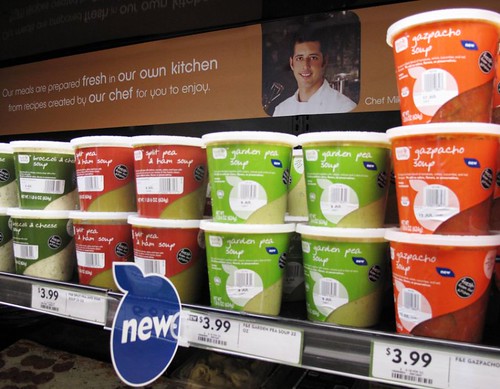
Additionally, Walmart has introduced a new line of ready-to-heat, refrigerated fresh soups (pictured above) under its Marketside brand.

The Marketside entrees and soups are similar to those marketed by Safeway (Signature Cafe store brand), Tesco's Fresh & Easy Neighborhood Market (fresh & easy brand) and a number of other U.S. food retailers. But the expansion by Walmart is significant from a competitive standpoint because the mega-retailer has thousands of U.S. stores in which it can sell the growing marketside fresh, prepared foods line

Walmart is in the process of launching the new Marketside fresh, prepared entree line and the fresh soup line in selected Supercenters and Neighborhood Market Supermarkets.

There will be additional items/varieties in the prepared entree line coming out soon, according to our sources and research.

The Marketside entrees and soups were originally created for Walmart's four small-format 'marketside by Walmart' fresh food and grocery stores located in the Metropolitan Phoenix, Arizona region, where the ready-to-heat fresh foods have been sold since the four stores opened in May 2008.

As we've reported and written about extensively, Walmart is using the 'marketside' stores as a laboratory for the development of its brand Marketside fresh foods program.

Walmart introduced its first Marketside branded fresh, prepared food item, a line of take-and-bake pizzas, to selected Supercenters and Neighborhood Market supermarkets last year. The pizzas were also developed at and are sold at the four Phoenix Metro region 'marketside by Walmart' stores.

Fresh & Easy Buzz reported in this December 21, 2009 piece - Wither Walmart's Small-Format 'marketside' Stores and Format? - that Walmart had replaced the Web site for its small-format 'marketside by Walmart' fresh food and grocery stores with a single page describing its new Marketside line of fresh foods.

We said this development signaled that Walmart was putting its primary emphasis regarding brand Marketside on the new fresh foods line rather than on additional 'marketside by Walmart' stores., which remains the case.

In our January 9, 2010 piece [Walmart's 'marketside': What's 'In-Store' for 2010?] we made three predictions about Walmart's brand Marketside for 2010.

One of those predictions was that Walmart would soon be rolling out additional fresh, prepared foods items under its Marketside store brand.

Here's what we said (in italics below) in prediction two of the three:

"Walmart will introduce a few additional packaged fresh, prepared foods items (SKUs) under its 'marketside' brand in some of its Supercenters, discount format stores and Neighborhood Market supermarkets in 2010, following up on the 'marketside' prepared, take-and-bake pizza.

Look for some or all of these prepared foods items in 2010: 'marketside' ready-to-heat fresh soups in containers and ready-to-eat packaged salads. Plus 'marketside' ready-to-heat prepared entrees in varieties like macaroni & cheese, meatloaf and pot roast, for starters."

Walmart is doing just what we predicted it would.

Walmart will be launching additional fresh, prepared - and other fresh foods - under its Marketside store brand this year.

Stay tuned.

[Click here and here for a selection of past posts in Fresh & Easy Buzz about Walmart's 'marketside' retail format and stores.]

[Editor's Note: In the past, Walmart used all lower-case letters for 'marketside.' It still uses lower-case for its 'marketside by Walmart' stores. However, Walmart is using Marketside (with a capital M) for its Marketside store brand. Therefore, we will follow this convention.]

Monday, October 6, 2008

'The Promotional Pundit:' How Wal-Mart Can Use its Supercenters to Create Customers For its New Small-Format Marketside Stores in Arizona

Pictured above is a 200,000 square foot Wal-Mart Supercenter in the Phoenix, Arizona Metropolitan area. There's plenty of room inside the mega-stores for a 400-600 square foot 'Marketside' promotional kiosk.

We've been discussing the theme in Fresh & Easy Buzz that Wal-Mart, Inc.'s new Marketside format and stores -- the first four which opened officially on Saturday in the Phoenix, Arizona area cities of Gilbert, Chandler, Mesa and Tempe -- are a different retail animal from a strategic positioning standpoint than Tesco's Fresh & Easy stores are because for Wal-Mart Marketside is just one part of a four-format (Supercenters, Sam's Club, Neighborhood Market supermarkets and now Marketside) food and grocery retailing retail format strategy while Fresh & Easy is currently a single-play, single-format strategy in the U.S. for Tesco.

For example, we discussed the theme as part of an observational, analysis and commentary piece in the Blog published yesterday: "Wal-Mart's Marketside is More Than the Sum of the Parts of its Other Formats; While Time and Consumers Will Judge, We See the Format As A Stategic Fit."

In this piece today we outline and explain what we believe is a powerful marketing and merchandising aspect and tool of Wal-Mart's multi-format food and grocery retailing strategy which the retailer could use to not only create what we believe could be thousands of new customers (trial) for its four Phoenix region Marketside stores, but also use as an ongoing high-impact, low-cost marketing and cross-promotional tool which leverages its existing resources.

Those specific existing resources are the Wal-Mart Supercenter stores located in and near the four cities where the Marketside grocery and fresh foods stores are located.

Wal-Mart has about 70 Supercenters currently open and operating in Arizona. Additionally, there are a number of these Supercenters in and around Gilbert, Chandler, Mesa and Tempe, the four cities where the new Marketside stores are located.

Each Wal-Mart Supercenter is a form of media in and of itself in that tens of thousands of shoppers visit a typical Wal-Mart Supercenter each week. That's why so many consumer packaged goods marketers use (and pay to do so) Wal-Mart as their in-store advertising and promotional medium -- point-of purchase displays, brand signage, in-store brand videos, ect. It's also why Wal-Mart uses what's referred to as in-store shopper marketing so frequently. This essentially is using the store as the marketing medium as we described above.

With that introduction to the premise, here is one marketing and merchandising campaign we would launch right away for the four Phoenix region Marketside stores using the various Wal-Mart Supercenters located in and around the four Phoenix area cities.

The Marketside Supercenter Kiosk Campaign

First, we would install a "Marketside Kiosk" in every one of these nearby Supercenters. The kiosk would be about 400 -to- 600 square feet in size and located in a promenant part of the Wal-Mart Supercenter. Many Supercenters have space in the front of the stores designed for such promotional purposes. So in most cases that's where our kiosk would go.

The design of the in-Superstore Marketside Kiosk would mimic how the Marketside stores look essentially in terms of graphics and the like. It would be a mini faux Marketside store if you will.

The focus of the kiosk would be informational -- with brochures about Marketside, coupons to be used at Marketside handed out and related informational pieces. The kiosk would have a person working in it at all store hours. It also would be sensual -- tastes of Marketside preapred foods items being sampled in the kiosk.

Additionally, the Marketside in-Superstore kiosk would focus primarily (but not exclusively) from a merchandising or product selection aspect on the prepared foods offerings at the Marketside stores.

Prepared foods

For example,there would be a service refrigerated case in the kiosk where a person would hand out free samples of a changing selection of the various fresh, prepared foods offered in the four Marketside stores.

Mini mock-up

The kiosk would also have some mock shelving and such with a representative selection of products sold in Marketside so as to create that "Mini Marketside" store effect for the kiosk as we described earlier. Doing so also provides and reinforces the informational purpose of the in-Supercenter Marketside Kiosk.

Cross-promotional tool

We also would use the kiosk (and parts of the Supercenter) as a cross-promotional tool.

For example, we would place point-of purchase signs at every checkout lane in the front-end of the Supercenters. These signs would tell customers checking out that if they purchased $25 or more at the Wal-Mart Supercenter they could come over to the in-store Marketside Kiosk with their purchase receipt and receive a coupon good for free prepared foods items (say a $6 dinner entree) at one of the four Marketside stores.

We would run this promotion say twice a week for a month to start to create impact. Also, doing so on a more frequent basis could get expensive.

This in-store promotion does two things. First it drives shoppers over to the in-Supercenter Marketside Kiosk. Second, it ties-in what they purchased at the Supercenter with what they now can get for free at Marketside. We think it's a safe bet the majority of the Supercenter shoppers aren't going to have been previously aware the Marketside stores exist. They would be with this in-store promotion. They also sould spread the news through word of mouth advertising.

The cross-promotion is all about creating awareness of -- and driving consumers to -- one or more of the Marketside stores. Since you are dealing with existing Wal-Mart shoppers under the Supercenter roof, that's an additional bonus, since there's an implied loyalty to Wal-Mart by virtue of the fact the shoppers are shopping a Supercenter.

A 'Taste of Marketside'

Another in-Supercenter promotional event we would hold, using the Marketside Kiosk as the central organizing principle and marketing vehicle in-store, is a "Wal-Mart Supercenter Taste of Marketside."

We would pick a Saturday in which we would bring in selected employees from all four of the Arizona Marketside stores to the nearby Supercenters. Sampling stations would be strategically set up throughout the Supercenter -- from the produce department to the automobile parts department -- where prepared foods items from Marketside would be sampled to Supercenter customers by the visiting Marketside store employees. Of course, as part of the tasting the employees would hand out Marketside brochures, coupons and other promotional goodies to Supercenter shoppers, along with the various "tastes of Marketside" in the form of the prepared foods samples.

Each shopper also would receive a raffle ticket from the folks at the sampling stations. We would hold a drawing every 30 minutes in which a $25 gift certificate for free goods at the Marketside stores would be given away.

In order to get in the drawing, the shoppers would have to bring their raffle ticket to the in-Superstore Marketside Kiosk. That's where the raffle would be held. The drawing would take place in the kiosk and the winner announced each 30 minutes over the store's public address system. This would serve to not only create excitement but bring the shoppers back to the kiosk for a second look at Marketside. (they also need to return to the kiosk to get their coupon when they win the raffle.) It also makes shoppers linger longer -- and perhaps make additional purchases -- in the Supercenter. That's promotional synergy.

Synergy

Such promotional campaigns as we describe above are all about creating synergies. And only multi-format retailers can do so in the way we describe.

Additionally, the promotion is all about the "piggy back effect." That is using the established "big guy" (the Wal-Mart Supercenter) to assist the new, fledgling "little guy," (Marketside). Of course because of the synergies, the "big guy" benefits from assisting the "little guy," which is how it should be in muti-format retailing cross promotions, as well as it should be with life in general.

Marketside Kiosk as central promotional element

The Marketside Kiosk is the central promotional element -- and glue -- of this in-Supercenter cross-promotional campaign. The actual tactics we listed and detailed are far from the only ones that can be used once the kiosk is set up in the Supercenters. Additional promotions can be created, as well as having additional promotions feed off the ones we described.

The store is the medium, the kiosk the message

The store (Supercenter) is the marketing medium and the Marketside Kiosk is the message.

Think of it as just another aspect of shopper marketing. But instead of promoting brands and products in-store, you're promoting one of Wal-Mart's other formats -- it's newest one and the one that is different from all the others because of its "food-centric" premise, Marketside.

A promotion like this, which is cheap and uses existing resources (the Supercenters), can only be done by a multi-format retailer, as we mentioned earlier. You've got to have more than one format and the stores to do it.

We think its powerful because of the captured consumer audience that exists in the Supercenters, the pleasure shoppers get from food sampling in-store, the synergies it creates for both Marketside and the Supercenters, and a number of other high-impact reasons.

Most important, it will create much awareness about and drive lots of new customers to the four new Marketside stores in the four Phoenix Metro region cities. And once that phase of the in-Supercenter campaign is over, the kiosk can easily be used if desired for various promotions designed not only to generate new custoemrs for Marketside but also to retain them, along with coming up with various ways to assist in increasing the market basket sizes at the Marketside stores.

Think of it using a trade show analogy as well. The Wal-Mart Supercenters are the trade show floor, the Markeside Kiosk is the trade show booth, and the Supercenter customers are all prospective customers for the trade show's (in this case Marketeside) product, which is being offered in the "booth."

After all, the "big guys' (Supercenters) should always be the first in the family (Wal-Mart, Inc.) to give an assist to the "little guy," (Marketside). And with such synergies in play, that "big guy" will gain additional benefits for giving his smaller cousin (Marketside) that helping promotional hand.

Coming soon: What Tesco's Fresh & Easy can do counter-promotionally as a single-format retailer.

Tuesday, June 24, 2008

Competitor News: Wal Mart Launches New 'Marketside' Website; Announces First Four Stores in Arizona to Open in the Fall Rather Than Summer


Wal-Mart has launched a new, colorful website for its Marketside small-format (15,000 -to- 20,000 square foot) community grocery stores and announced today its first four combination grocery and fresh foods stores in the Phoenix Metropolitan/East Valley region cities of Gilbert, Mesa, Chandler and Tempe will open in the fall rather than this summer as the retailer originally had planned.

View the new Wal-Mart Marketside website here.

Fresh & Easy Buzz first reported last year Wal-Mart would open the first four of the new Marketside format stores in these Arizona cities. Wal-Mart confirmed this two months ago when it created the website workformarketside.com where it listed job postings and began excepting online applications for store manager and assistant manager positions at the four Marketside stores in these four Arizona cities.

Wal-Mart originally planned to open at least one or more of the four stores this summer, according to our sources. In fact, it was hoped the first store would open before August 4, when David Wild, Wal-Mart's senior vice president for business development and the head of the Marketside format development team, leaves the company to become CEO of Halfords, a United Kingdom-based car part and bicycle retailer.

Based on Wal-Mart's announcement today, that's not going to be the case. Wal-Mart offered no specific month or date this fall when the first store would open; just that they will open in the fall of 2008.

As we've reported previously, Wal-Mart's Marketside will have its own offices in Tempe, Arizona, rather than being operated out of Wal-Mart corporate headquarters in Bentonville, Arkansas. Starting on June 30, Marketside will open a recruiting office to hire for the Arizona stores at this address: 800 E. Southern AvenueTempe, AZ 85282. Marketside has already been accepting applications and conducting interviews for positions. But the opening of this recruiting office will kick the process into high gear, according to our sources.

The new Marketside website positions the stores as we've been reporting for months now, as small "community grocery stores" with a focus on fresh foods and basic grocery items. In fact, on the new website, Wal-Mart describes Marketside this way "Marketside is a small community grocery store owned by Wal-Mart Stores, Inc."

Interestingly, Tesco originally planned to name its Fresh & Easy USA division and stores, Fresh & Easy Community Market, but changed it to Fresh & Easy Neighborhood Market after the retailer said research with focus groups demonstrated a preference for "Neighborhood" over "Community" in the name. [This has been publicly stated by both Tesco PLC CEO Terry Leahy and Tesco Fresh & Easy Neighborhood market CEO Tim Mason. Tesco makes no mention on the Fresh & Easy website that Fresh & Easy Neighborhood Market is owned by Tesco, like Wal-Mart does mention about Marketside being owned by Wal-Mart on the new Marketside website.]

Ironically, Wal-Mart's original small-format supermarket (at least small-format for Wal-Mart at the time at 45,000 square feet), which it continues to expand in terms of store count, is called Wal-Mart Neighborhood Market. Wal-Mart built its first Wal-Mart Neighborhood Market store in 1998, which was the last time it launched a new format until now with Marketside.

The Marketside website plays up the stores' and its workers "passion" for food, especially fresh foods, with pictures and text about food and Marketside's commitment to offering "the freshest food available in-store and the best customer service."

As we've reported, the Marketside stores will have in-store kitchens where the fresh food items will be prepared, along with a seating area that will sit about 10 customers at any one given time. Take-out is expected to be the big draw for the fresh in-store, prepared foods in the stores however.

Tesco's Fresh & Easy Neighborhood Market makes its fresh, prepared foods at a central kitchen in Southern California and ships the items to its current 61 stores in Southern California, Nevada and Arizona.

The new website also makes an effort to reinforce the message that Marketside prices will be value-oriented, rather than having high prices like some publications have been suggesting recently in various stories using the angle that Wal-Mart plans to open upscale and high-priced small-format stores.

Wal-Mart's positioning for Marketside--fresh, quality foods at affordabel prices--is clear from reading this key introductory statement on the website reprinted below:

Welcome to Marketside

"Marketside provides fresh, innovative answers to the daily question, "What's for dinner tonight?" Our unique product and shopping experience will change the way you shop for — and think about — fresh food, and our prices will keep you coming back."

It's clear Wal-Mart is positioning Marketside as a small, community grocery store as it calls it, featuring basic groceries and fresh foods with a clear value proposition.

Our sources have told us all along, and we have reported, that the Marketside stores will be slightly upscale but also will offer value pricing, which is Wal-Mart's stock in trade across all of its formats.

The new Marketside website also has photographs of the uniforms (burnt red-color grocery aprons with Marketside in gold lettering) store-level employees will wear. The uniforms, which are in the same colors used in the website and in other Marketside design and marketing elements and materials (hint: look for these to be the design colors used in and outside the stores) are designed to depict "freshness," which is the key marketing and positioning element for Marketside.

The website also features a sign up area here called "Stay in the Know," where consumers can sign up to receive a Marketside newsletter on a regular basis as well as receiving email up dates about Marketside.

The new Marketside website incorporates Wal-Mart's earlier job listing-only website (http://www.workformarketside.com/), including having listings in its "Join Our Team" section for the new store-level Pantry Controller and Meal Specialist positions Fresh & Easy Buzz was the first publication to report on in this piece yesterday, along with the store manager and assistant manager positions.

As Fresh & Easy Buzz reported in this piece on May 18, "Wal-Mart Looking For Sites in California For it's Small-Format 'Marketside' Grocery Stores," Wal-Mart is looking throughout California for future Marketside store sites.

In addition, in this June 6 piece, "Is A Wal-Mart 'Marketside' Small-Format Grocery and Fresh Foods Store Coming to Reno, Nevada?,"we reported Wal-Mart is interested in locating a Marketside store in this new and upcoming commercial development in Reno, Nevada.

In this piece, "Wal-Mart USA Chief Eduardo Castro-Wright Confirms Fresh & Easy Buzz Reportage on 'Marketside,' Adds Information From the WM Corporate Side," from our coverage of Wal-Mart's annual meeting on June 6, Wal-Mart CEO Eduardo Castro-Wright himself confirmed Marketside would have a value pricing proposition along with its more upscale fresh foods focus and basic grocery offerings.

It's obvious to Fresh & Easy Buzz that Wal-Mart plans to use Marketside as part of its three format--Supercenters, 45,000 square foot Neighborhood Market's and now Marketside--food and grocery retailing strategy in Arizona to become the market share leader in the state.

It's also obvious that although doing some things differently than Tesco with its Fresh & Easy, Wal-Mart plans to use Marketside, along with its other formats, to attempt to strike a serious competitive blow to the start up Fresh & Easy chain.

It looks like readers and others will have to wait until the fall to see the Fresh & Easy vs Marketside battle begin (the first four Marketside stores are very close to existing Fresh & Easy stores) rather than this summer.

That gives Tesco time to open more Arizona Fresh & Easy stores as well, which it will soon start doing after ending its three month new store opening pause on July 2 when a new store opens in Manhattan Beach in Southern California. New Arizona stores will start opening shortly after that date. Their currently are about 20 Fresh & Easy grocery markets open and operating in Arizona.

The launching of its new Marketside website by Wal-Mart though is a clear indication things are getting serious with the world's largest retailer when it comes to its new Small-Mart development, Marketside. After all, fall is just around the corner.

Sunday, February 28, 2010

Walmart Launching New Value-Added Pre-Packaged Fresh Produce Line Under its Marketside Fresh Foods Brand


Fresh Foods Merchandising: Value-Added Produce Category

Walmart Stores, Inc. is introducing an extensive new line of value-added fresh, bagged and pre-packaged produce items under its Marketside fresh foods brand, Fresh & Easy Buzz has learned.
Thus far, the line includes 17 SKUs in the following categories: Fresh, bagged or pre-packaged spinach greens, salad mixes and lettuce, value-added fresh veggies, and a fresh salsa item.

All of the value-added fresh produce items come in either clear bags or plastic packages/tubs. Below are the 17 new Marketside value-added fresh produce items, detailed under the four categories we've created and grouped them under:


Spinach Greens

>Marketside Fresh Spinach, 10 oz
>Marketside Organic Baby Spinach, 10 oz
>Marketside Organic Baby Spinach, 5 oz


Microwave In-Bag Value-Added Veggies

>Marketside Broccoli Cauliflower, 12 oz
>Marketside Broccoli Florets, 12 oz
>Marketside Broccoli/Cauliflower/Carrots Vegetable Medley, 12 oz
>Marketside Snow Peas, 8 oz
>Marketside Sugar Snap Peas, 8 oz


Salad Mix, Salads & Lettuce

>Marketside Classic Iceberg Salad, 12 oz
>Marketside Classic Iceberg Salad, 24 oz
>Marketside Classic Iceberg Salad, 6 oz
>Marketside Shredded Iceberg Lettuce, 8 oz
>Marketside Broccoli Slaw, 12 oz
>Marketside Organic Herb Mix, 5 oz
>Marketside Organic Spring Mix, 10 oz
>Marketside Organic Spring Mix, 5 oz

Fresh Salsa Mix

>Marketside Mild Pico De Gallo, 10 oz

Five of the 17 bagged and pre-packaged fresh produce items are organic, as you can see in the above list.

Walmart is launching its new Marketside value-added, bagged and packaged fresh produce items in selected Supercenters and Neighborhood Market supermarkets.
Some of the 17 items have been sold at Walmart's four small-format 'marketside by Walmart' fresh food and grocery stores in Metropolitan Phoenix. Those stores opened in May 2008.

Earlier today we reported on and detailed that Walmart is introducing a new line of pre-packaged, ready-to-heat fresh, prepared entrees and soups under its Marketside store brand. [February 28, 2010 Walmart Introducing New Ready-To-Heat Prepared Entrees, Fresh Soups Under its Marketside Brand] The two new lines follow Walmart's introduction last year of its Marketside take-and-bake pizza line.

The extension of store brand Marketside to the new pre-packaged, value-added fresh produce line shows Walmart plans to use Marketside as a complete fresh foods store brand, including fresh produce - and other types of fresh foods - under the brand, along with the fresh, prepared foods line.

Interestingly, the new Marketside value-added fresh produce line includes not only the upscale, specialty items like the fancy and organic greens, but also more basic items like the iceberg lettuce and fresh vegetables.

For those who haven't thought Walmart isn't planning to exploit "Fresh," this new development, along with the Marketside fresh, prepared foods line extension, should offer a change of mind.

Additionally, Walmart will be rolling out additional fresh foods items under its Marketside store brand. Stay tuned.

Saturday, December 18, 2010

Walmart Launches New 'Marketside' Fresh Food Lines - Plus A 'Fresh' Campaign to Create Brand Buzz

Private Brand Showcase: Fresh Foods

Walmart Stores, Inc. has been busy creating and launching new fresh food product lines under its "Marketside" private brand, along with adding new SKUs to its existing lines, since we last reported on and wrote about the introduction of a new line of "Marketside"artisan breads and related baked goods in September. [Read the story - September 9, 2010: Walmart Introduces 'Marketside' Brand Packaged Fresh-Baked Breads, Sub Rolls and Chocolate Chunk Cookie.]

Since then, Walmart has launched three notable new "Marketside" lines: a line of ready-to-use refrigerated dips (for chips, crackers, fruits and veggies); a cook-in-three-minute fresh, refrigerated pasta line; and a companion line of ready-to-heat fresh-prepared pasta sauces.


Dips: The extensive line features numerous SKUs, including Guacamole; a range of ranch dips like Chipotle Ranch and Buttermilk Ranch; Bleu Cheese; a cream cheese and vanilla bean fruit dip; and others.


Fresh Pasta: The "Marketside" line of fresh, refrigerated pasta includes numerous pasta shapes, along with ravioli and tortelloni varieties filled with meat and cheese, like the Three Cheese Tortelloni pictured above. All of the fresh pasta varieties take three minutes to boil.

Pasta Sauce: The "Marketside" refrigerated, fresh-prepared pasta sauces come in tomato-based and cream varieties, as well as pesto. The cream-based sauce varieties include the Asiago and Smoked Provolone cheese sauce pictured above. The tomato-based marinara sauce varieties include the Tuscan-Style Marinara Sauce, also pictured above.

Walmart has yet to add the new "Marketside" fresh pasta, pasta sauce and dip lines, as well as some of the new SKUs added to the existing lines, to its Marketside.com product website.

Walmart's "Marketside" private brand now includes lines and products in the fresh-prepared foods, fresh produce and bakery categories.

The fresh-prepared food lines include both ready-to-eat items - grab-and-go salads and sandwiches; party trays; Rotisserie chicken and other meat and non-meat items and side dishes; plus the dips and sauces - and ready-to-heat or quick-cook items, such as entrees, side dishes, pizzas, pastas and sauces.

There's also a line of "Marketside" packaged fresh cheese and a line of packaged lunch meats which are sold in some Walmart stores.

The fresh food products are sold in the retailer's Walmart Supercenter, Walmart Neighborhood Market and marketside by Walmart banner stores in the U.S. Additionally, selected "marketside" items are also sold in some of the retailer's discount format stores.

The product grouping above - the ready-to-eat rotisserie chicken and take-and-bake pizza, along with a bag of fresh spinach, a loaf of fresh bread and a cookie - is a good graphic depiction of the "home meal replacement" marketing positioning focus Walmart is using for its "Marketside" fresh foods brand.

Home meal replacement positioning, building brand buzz

Walmart's strategic vision and marketing strategy for "Marketside" is to create a multi-line family of fresh food products and position them to shoppers as an affordable, fresh and high-quality "home meal solutions" brand and concept, which it has started doing, using a handful of marketing and promotional vehicles.

The retailer's new campaign for "Marketside," which began the first week of November, is designed to create online buzz around the brand by engaging food-oriented bloggers and "mommy" bloggers, many who are members of Walmart's moms' blogger group.

The "home meal replacement" positioning for brand "Marketside" is the central theme of the campaign. Boulder, Colorado-based design and corporate identity firm Mighty Fudge Studios, the creators of the "Marketside" product packaging, prepared an attractive and detailed collateral piece for the week-long promotion. The package was sent to the bloggers as an information piece about the brand, along with inviting them to receive a selection of free "Marketside" products over a period of time, which they could try and hopefully write about in their respective blogs, thereby creating some desired online grassroots buzz for and around the brand.

The marketing communications piece (pictured above) uses the "home meal solutions" positioning as its overall theme, focusing the "Marketside" brand message on that key element.

A number of the food-oriented and "mommy" bloggers who received the free products and market communication piece have since posted about the "Marketside" products, along with posting recipes they created using the fresh food items.

More brand 'Marketside' to come

In addition to introducing the new "Marketside" fresh food lines, Walmart has added new SKUs to many of its existing lines over the last couple months, such as new fresh bread items, ready-to-heat refrigerated soup varieties, value-added produce items and a some others.

New line creation and SKU expansion are far from over at Walmart for brand "Marketside." The retailer is currently working on additional new fresh food lines, including prepared-foods, and new SKUs to add to the existing lines, for introduction in the first half of 2011.

Stay tuned.

Related Stories

September 9, 2010: Walmart Introduces 'Marketside' Brand Packaged Fresh-Baked Breads, Sub Rolls and Chocolate Chunk Cookie

March 31, 2010: Walmart Adds Additional Marketside Fresh Food Items to Marketside.com Not Long After Our February Reports

March 9, 2010: Walmart Adds Two More SKUs to its Marketside Ready-To-Heat Fresh, Prepared Entree Line

March 2, 2010: Walmart Launching New 'Marketside Fresh Garden Salsa' Line Under its Fast-Growing Fresh Foods Store Brand

February 28, 2010: Walmart Introducing New Ready-To-Heat Prepared Entrees, Fresh Soups Under its Marketside Brand

February 28, 2010: Walmart Launching New Value-Added Pre-Packaged Fresh Produce Line Under its Marketside Fresh Foods Brand

Sunday, October 5, 2008

Wal-Mart's Marketside is More Than the Sum of the Parts of its Other Formats; While Time and Consumers Will Judge, We See the Format As A Stategic Fit


Observation, Analysis and Commentary

Yesterday and today Fresh & Easy Buzz was able to visit each of the four Wal-Mart Marketside stores in Gilbert, Chandler, Mesa and Tempe, Arizona which officially opened yesterday, October 4, although as we previously reported had soft openings on Thursday and Friday.

We spent a considerable amount of time in each store not only analyzing the store design, merchandising, pricing and prepared foods offerings but also talking to shoppers and employees.

First though some back story. As we've been writing since January, 2008, Wal-Mart's retail strategy with its small-format (the four Phoenix, Arizona region stores range from about 15,000 -to- a little over 17,000 square feet) combination grocery and fresh foods Marketside stores is not the same as Tesco's strategy with its small-format (10,000 -to- 13,000 square foot) Fresh & Easy Neighborhood Market combination grocery and fresh foods stores.

For Tesco, Fresh & Easy is (at least currently) a single format food and grocery retailing strategy for the Western U.S. -- California, Nevada and Arizona at present. The plan is to open around 300 of the stores by sometime in 2010. In other words, right now Fresh & Easy is a single-play strategy in the U.S. for Tesco, which is a multi-format retailer at home in the UK and elsewhere throughout the world.

Additionally, a part of that single-format strategy is to locate the Fresh & Easy stores within a couple miles of each other in the respective market regions so as to create what we call a "critical mass" retailing strategy. Think of it as Fresh & Easy attempting to become the de facto neighborhood grocery store in the various neighborhoods in these respective market regions by virtue of having so many stores located in a concentrated area so close to one another. Tesco's models in this regard are the drug store chain Walgreens and Starbucks in the coffee retailing space, both which use a "critical mass" retail store location strategy. In many ways this is a logical store location tactic for a retailer conducting a single format food retailing strategy.

On the other hand, as we written about before, Marketside is a part (the most recent addition) of Wal-Mart's national (U.S.) multi-format food and grocery retailing strategy.

The lead horse of that strategy is the Wal-Mart Supercenter, the retailer's mega-combination food, grocery and general merchandise stores that average about 187,000 square feet.

Along with the Supercenter, Wal-Mart operates Sam's Club membership warehouse stores which carry a strong selection of fresh food and grocery products at discount prices.

Along with these two food and grocery selling formats, Wal-Mart also has its 40,000 -to-45,000 square foot Wal-Mart Neighborhood Market, which are standalone supermarkets.

And now there is Marketside, the fourth strategic horse so to speak, and smallest format store Wal-Mart has ever created. [We aren't including Wal-Mart discount stores even though they sell a selection of groceries (but not fresh produce or meats) because they aren't part of the modern Wal-Mart food and grocery retailing strategy.]

Some observations

Marketside is a hybrid in some ways of the Wal-Mart Neighborhood Market in that Marketside offers a selection of basic food and grocery items with a focus on national brands. But Marketside's merchandising is qualitatively different than the Wal-Mart Neighborhood Market supermarket format in that its what we call "food-centric," meaning Marketside puts a major positioning focus on fresh foods, even calling the grocery products in the stores "ingredients" rather than groceries.

Marketside also is designed for convenient in-and-out shopping, yet puts a major emphasis on service, offering full-service checkout as well as including a full-service deli in the store. In the service regard Marketside is much more a small version of a modern Whole Foods Market than it is a format similar to Tesco's Fresh & Easy or Trader Joe's. Yet it's more than that because it also sells basic grocery items. Marketside also offers a strong, limited assortment of top organic brands.

These service and "food centric" themes carry over to Marketside's prepared foods offering. There's a kitchen with a wood burning, open hearth oven in-store, along with a small "eat-in" seating area for customer/diners.

Not all of the prepared foods sold in the stores are actually made in the store. However, the in-store kitchen is as much a perception (read fresh) creator as it is a functional attribute to Marketside's prepared foods offering.

Our observation from watching shoppers in all four stores, along with talking to many of them, is that the in-store kitchen, along with the eating area, serves as a sort of semiotic signal to shoppers signaling "fresh."

The Marketside in-store kitchen/service deli offers Wolfgang Puck-type artisanal pizzas which are cooked in the kitchen's wood burning oven, as well as whole chickens which are prepared in-store on a rotisserie, for example. This isn't anything radical -- upscale U.S independents have been doing both things for decades and many big chain supermarkets do it now -- but it is different in terms of what the major small-format U.S. players thus far -- Tesco's Fresh & Easy, Trader Joe's, and on the hard-discount end Sav-A-Lot and Aldi -- are doing with prepared foods. it also fits into the "food centric" positioning of Marketside.

There also are sushi chefs (a concept taken from Whole Foods and numerous other upscale food retailers) preparing sushi right in-store.

The Marketside stores' fresh produce departments were full, abundant and fresh-looking on our visits. They also feature, as we've been reporting they would for months, mostly bulk produce displayed farmers market style. Additionally, most of the pre-packaged produce is branded with well known names like Dole, Fresh Express and the like, as is the case in most U.S. supermarkets -- and in Wal-Mart's Supercenters and other food retailing format stores.

This in our analysis is a smart thing for Wal-Mart to do with the fresh produce category in the Marketside stores based on the overall "food-centric" gestalt of the stores and what Wal-Mart is trying to do positioning-wise with the format.

For example, although Trader Joe's does very well with its pre-packaged produce and Fresh & Easy has seen fresh produce category sales progressively increase with its nearly 100% pre-packaged produce program, it's our analysis American consumers still prefer having a majority of bulk produce to choose from in their food stores.

U.S consumers like value-added pre-packaged produce considerably -- salad kits and the like -- and also like and often prefer certain items pre-packaged -- berries, herbs, spinach and some others. But in the main the preference remains for bulk, both because it offers more choice in terms of item purchases (you can buy one cucumber or Italian squash rather than a package of three for example) but also because bulk, abundant produce displays appeal to American (especially in the west) consumers' concept of fresh. It's a cultural-socio--psychological characteristic. For example, if you've ever experienced how a Brit or Irishman reacts when served a pint of Guiness ice cold rather than room temperature in an American bar, you understand what we mean by a cultural-socio-pychological characteristic vis-a-vis bulk and pre-packaged fresh produce among the majority of American consumers.

Basic groceries

A significant aspect of the Marketside store format is that the stores offer a strong but limited assortment of basic shelf-stable food and grocery items -- packaged goods. The vast majority of these products are well-known U.S. national and regional brands -- Folgers Coffee, Best Foods Mayo, Heinz Tomato Ketchup and the like, rather than store brands or private label.

We think Wal-Mart did this for three primary reasons.

>It's the safe way (no retail chain pun intended) to start out. Last year Wal-Mart trademarked a couple new store brand names -- "Wild Thymes" and Field and Vine --" specifically with Marketside in mind. However, instead of using those store brand names to create a store brand mix of say about 65% store brand -to- about 35% national and regional brands like Fresh & Easy and Trader Joe's (more like 75% store brands 25% other for TJ's) using say these two new brands, Wal-Mart has opted to focus on the national and regional manufacturers' brands in the stores for now.

> The second reason we believe Wal-Mart put this focus on the national and regional manufacturer's brands in the packaged goods category (and it's related to the reason above in part) is because it allows Wal-Mart to further leverage it dominance as the number one retail customer (buyer) of manufacturers' brands in the U.S. There's tons of street and promotional money Wal-Mart can get from these vendors, which Fresh & Easy and TJ's for example can't because both chains carry so view a percentage of the "big brands," which will come in handy for its Marketside startup.

>Third (and related to one and two above), Wal-Mart knows based on the information in its extensive consumer data base that even though store brands are experiencing a significant gain in popularity in the U.S., American consumers still tend to prefer national and regional manufacturers' brands, as long as they are priced well. This is the case in Wal-Mart's Supercenters. With manufacturer coupon use by consumers at an all time high in the U.S. do to high food inflation and thus soaring retail prices, this offers another plus for the Marketside national brand strategy.

National brands: Price

With this in mind, we paid close attention to the retail prices of numerous national branded packaged goods items in the four Marketside stores we visited yesterday and today. We then visited a Wal-Mart Neighborhood Market supermarket and a Wal-Mart Supercenter, comparing the prices on some of the same items offered in Marketside and the two other Wal-Mart format stores.

What we found in the main is that the prices on the items in the Marketside and Wal-Mart Neighborhood Market supermarkets were about the same, exclusive of items on promotion at either format store. The Marketside prices were however higher on the same items at the Supercenter in the range of about 5 -to- 15%.

We also checked two supermarkets, a Safeway Store and a Bashas. Overall Marketside prices on national branded packaged goods items were in line with the everyday prices in those two stores, exclusive of advertised or in-store promotions.

Prices on like basic items at two Fresh & Easy stores (fresh & easy store brand items compared to like or similar national brand items) were lower than they are at the Marketside store by about 6 -to-12%, based on the 15 or so key items we compared. We aren't suggesting we took a market basket survey. By design and time constraints it was a small comparison of key grocery items.

Pricing the branded packaged goods items in the Marketside stores a bit higher than in the Supercenters makes sense for Wal-Mart to do. After all, as we've said, Marketside is merely one part of a current four-format (by the way there's going to be a new, fifth national food and grocery Wal-Mart format we will be reporting on soon. Hint: it isn't small-format) food and grocery retailing strategy. And of course, the stores just opened. Pricing will be adjusted of course, as it is by all retailers.

Analysis: The Marketside format and more

It's our analysis Wal-Mart has created its own, differentiated format with Marketside. It's neither a copycat of Trader Joe's or Tesco's Fresh & Easy (many similarities of course) and it certainly isn't a copycat of Sav-A-Lot or Aldi.

Marketside also has numerous similarities to the hybrid eastern USA convenience store/ grocery store chain Wawa, which we've written often about as being a small-format pioneer in the U.S. However it's far from a Wawa clone either.

Their also are similarities between Marketside and Giant Eagle, Inc.'s small-format hybrid grocery/convenience-oriented format Giant Eagle Express, which we've also written about in the past. But the qualitative differences in Marketside far outweigh the similarities.

The closest chain store small-format relatives to Marketside are Safeway's "The Market" format, which is currently represented by just one store, "the market by Vons" in Long Beach, California, and Supervalu, Inc.-owned Jewel-Osco supermarkets' "Urban Fresh by Jewel." The first store of the format recently opened in Chicago, Illinois.

Wal-Mart actually began development of Marketside (late 2006-early 2007) before Safeway (mid-2007) did with its "The Market" format or Supervalu's Jewel (early 2008) did its development of "Urban Fresh." Therefore it's fair to say Safeway's "The Market" and Jewel Osco's "Urban Fresh" are the younger cousins of Wal-Mart's Marketside even though each of those two chain's stores opened first.

Marketside also isn't a clone of Tesco's Fresh & Easy. There are obviously many similarities. Chief among them the basic premise of offering a combination of basic groceries and prepared foods, which Tesco certainly did first with Fresh & Easy. And there's the convenience-orientation of both stores. Again Fresh & Easy was first.

But there are enough differences in Wal-Mart's Marketside format for us to conclude the retailer has created its own small-format store, rather than merely reacting to Tesco's Fresh & Easy, Trader Joe's or others.

Of course, as we've reported for months now, the decision by Wal-Mart to open the first four Marketside stores in the Phoenix Metropolitan region -- each of the four stores being about 1 -to- 2 miles from Tesco Fresh & Easy stores -- is clearly a signal to Fresh & Easy, and inspired in part by Tesco's making the region on of its first three markets in the Western U.S. Southern California and Metro Las Vegas, Nevada being the other two regional markets for Fresh & Easy.

However, it all depends on which foot that particular retail shoe goes on, to use a footwear metaphor that perhaps lacks a bit of "sole."

For the last five -to- 10 years, Arizona, and particularly the Phoenix Metropolitan regional market, has been one of Wal-Mart's top-three market region focuses in the U.S. Therefore, when Tesco decided to make the Phoenix market one of its first three launch targets for Fresh & Easy, Wal-Mart took that in part as a direct competitive attack by the world's third largest retailer on its (the world's largest retailer) plans to become the dominant food retailer in the region, which it now is with about a 26% market share.

Therefore, perhaps in the corporate eyes of Wal-Mart it's merely returning the favor to Tesco by opening its first four Marketside stores in the region, which after all has been one of its top three focus markets for many years now. An industry analyst at a major investment banking firm told us a few years ago that if you said the word "Arizona" to Wal-Mart CEO Lee Scott at that time, he would almost break out in a song (Glen Campbell's "By the Time I Get to Phoenix" perhaps) and happy dance routine.

Wal-Mart also didn't appreciate that Tesco decided to name Fresh & Easy "Fresh & Easy Neighborhood Market," since it's used "Neighborhood Market" for its standalone Wal-Mart Neighborhood Market supermarkets for over a decade.

Tesco originally was going to call Fresh & Easy Neighborhood Market "Fresh & Easy Community Market." However, Tesco decided to change it to "Neighborhood Market" rather than "Community Market" after focus group research the retailer did showed consumers preferred the more intimate "Neighborhood" wording over the larger "Community" term. Ironically, although Wal-Mart doesn't use it in the store name, it is referring to Marketside in its marketing literature and on its website as "a small community food and grocery store."

{The term "community" has an interesting double meaning and usage in the U.S. On the one hand it has very positive connotations, suggesting people coming together. On the other hand it has negative connotations and is sometimes used in a derisive manner, especially in politics to suggest socialistic leanings. Notice how the Presidential campaign of Republican John McCain has been using the term "Community Organizer" regarding the time when Democratic candidate Barack Obama did that work for a living, for example. It's not meant as a positive.}

Marketside as Wal-Mart's utility infielder format

Since we started the analogy trend above with the footwear reference, we will use one more. That analogy is in our analysis we see Marketside as Wal-Mart's food and grocery format equivalent to the utility infielder on a professional baseball team.

In baseball the utility infielder is the one the team manager can call on to play more than one infield position at different times during a season.

For example, perhaps the team's starting second baseman pulls a muscle in May and is out for 4 weeks. The utility infielder steps in and takes his place at second base for a month.

Then in August the third baseman gets arrested for a DUI and the team owner suspends him from playing for three weeks. The utility guy takes his place at third base while he is on suspension.

Lastly, the team makes it to the playoffs in September, only to have the shortstop trip and fall in the locker room, breaking a leg which puts him out of commission for the entire playoffs. Who are you going to call to fill in? Yes, the same utility infielder who's been rather busy this season. He will cover shortstop for the playoffs and if they win for the World Series.

In a similar regard, since it is part of a multi-format food and grocery retailing strategy for Wal-Mart rather than a single-play format like Fresh & Easy is for Tesco in the U.S., the retailer can use Marketside selectively.

For example, as we've often said, small-format Marketside can be an urban strategy for places like the city of San Francisco and parts of the Bay Area (as well as Los Angeles) where political and community opposition has prevented Wal-Mart from opening anywhere the number of its mega-Supercenters as it's wanted to and tried to open in the respective regions. Also in general Marketside is a good urban strategy just because of the density of such cities and regions, along with space limitations and the often high real estate costs. New York, Chicago, Philadelphia, Washington D.C. -- the list of cities and urban regions in the U.S. is a long one for a Marketside urban retail location strategy.

Additionally, Marketside can be used as a selective suburban region strategy for suburbs in the U.S. that are either already fast-growing or are emerging in affluence and population, like Chandler, Gilbert, Mesa and Tempe, Arizona are. There are lots of those in the U.S. It's also great for suburbs where there's a high population of "foodies," like in Southern California, the Bay Area, New York, Boston, Seattle and many other regions.

Further, Wal-Mart can even use Marketside for what we call a "dual-format" or "co-located" store strategy in selective cases. This is something we've mentioned before in Fresh & Easy Buzz in relation to Marketside but haven't elaborated on much.

Let us explain. The United Supermarkets chain, which among the formats it operates includes an upscale banner called Market Street, has created a "mini" Market Street store called a "Taste of Market Street," which is located in the same parking lot (like two minute walk close) as its "third generation" Market Street supermarket at 98th & Quaker in Lubbock, Texas.

The" co-located" "mini" "Taste of Market Street" store is only 1,300 square feet. It's an upscale format hybrid grocery and convenience store. The "mini" Market Street offers a mix of basic grocery items, organic and specialty foods, some convenience store-style GM and non-foods items and ready-to-eat and ready-to-heat prepared foods items. It has gas pumps as well. It's a tiny version of its big brother supermarket across the way, with a few qualitative differences.

The premise of the "co-located" "Taste of Market Street" store format is to offer a convenient but yet upscale (along with some basics) convenient store as an adjunct to the chain's very nearby Market Street format supermarket. United Supermarkets plans to "co-locate" more of the little stores, which focus on prepared foods and the other items, in parking lots with its Market Street banner supermarkets.

Following the United Supermarkets Market Street and "Taste of Market Street" example and precedent, we can see Wal-Mart in selective cases "co-locating" a Marketside store close by an existing Supercenter. For example, in the front of the Supercenter or near the side. The parking lots are huge after all.

Even more compelling, we could see the retailer "co-locating" Marketside stores on a selective basis nearby existing Wal-Mart Discount Stores, which sell a limited assortment of dry grocery and perishable items in pantry departments but offer no fresh produce, meats, deli or prepared foods. The Marketside stores don't particualrly have to be in the same parking lot as the discount format stores even. They could be strategically located nearby.

In some cases "co-locating" Marketside stores with Sam's Club membership stores also could make good sense.

Additionally, who says all Marketside stores have to range from 15,000 -to- 20,000 square feet? The format is adaptable.

A "Mini Marketside" version 2.0 could be easily created, say a 3,000 -to- 10,000 square foot version, or something similar. The smaller version would put a much greater emphasis on prepared foods and far less on grocery items. After all, being "co-located" near a Supercenter, which offers a full selection of groceries, or a Wal-Mart Discount Store, which offers about as much in the grocery category as a regular Marketside does, would make it a bit redundant to have too many grocery skus in the store. Therefore, a greater emphasis on prepared foods in these "co-located" "Mini Marketside" would make perfect sense.

We call this the Marketside "co-location" strategy, which makes a third form of utility for the format along with the urban and suburban retail strategies we discussed above. The urban, suburban and "co-location" strategies demonstrate how versatile a small-format store can be when it's part of a retailer's multi-format portfolio.

Marketside and Fresh & Easy

Because Wal-Mart's Marketside has in our analysis enough qualitative format differences to make it distinct from Tesco's Fresh & Easy, along with the fact it is one part of a multi-format food and grocery retailing strategy for Wal-Mart, we don't believe the success of Fresh & Easy Neighborhood Market will be based significantly on how Marketside does, even if it performs beyond Wal-Mart's expectations wildly and the retailer grows the store count rapidly over the next couple years in California, Arizona and Nevada.

Rather, we believe Tesco Fresh & Easy's success or lack of success will be the result of the retailer's own making and performance in the main.

Certainly in those cases like the four Arizona cities where Marketside stores are so near Fresh & Easy units there will be competition. Therefore Marketside will be a factor in the success or failure of Fresh & Easy stores in those cases and situations.

However, for the reasons detailed above, overall we believe Fresh & Easy's success or failure rests with Tesco more so than anything Wal-Mart does or will do with Marketside.

This goes against what many are suggesting is the small-format battle and standoff between Wal-Mart and Tesco.

Don't get us wrong, we aren't suggesting Marketside and Fresh & Easy aren't going to be direct small-format store competitors in some cases and perhaps in many ways overall down the road. What we are saying is that Fresh & Easy's sucess depends primarily on Tesco and its execution and operations of the chain rather than it does on anything Wal-Mart does with Marketside. The same can be said for Marketside, although being one part of a multi-format strategy makes it different in both kind and degree.

We also have no idea if Marketside will be a success for Wal-Mart.

However what is a fact in our analysis is achieving success with Marketside for Wal-Mart is far easier than it is for Tesco with Fresh & Easy because Fresh & Easy is that single-format play for Tesco in the U.S., while Marketside is that small part of the overall multi-format strategy for Wal-Mart. Failure also would come at a much lower financial cost for Wal-Mart with Marketside, compared to the financial cost of failure for Tesco with Fresh & Easy based on the respective investments both companies have in each of the banners.

But as we often say the jury remains out on Tesco's Fresh & Easy in our analysis. We suggest those who count them out do so at their own peril, or at least potential embarrasement.

We also believe in many ways if Tesco's Fresh & Easy is a success, it will be a more pronounced one than if Wal-Mart is a success with Marketside.

Tesco's Fresh & Easy format and stores are what we call far more 2.0 version grocery stores than Wal-Mart's Marketside is. With its self-service checkout model, prohibitions against accepting paper personal checks and cashing payroll checks, its majority focus on store brands, near 100% pre-packaged produce, along with a few other things, Tesco's Fresh & Easy stores are a far more radical departure (the 2.0 grocery store title) from maintream food and grocery retailing formats in in the U.S.

Wal-Mart's Marketside on the other hand is as we said a format all to its own but is well within the mainstream of U.S. food and grocery retailing -- full-service checkout, paper checks are fine, more national brand items than store brand, for example.

Therefore, for Tesco with Fresh & Easy its: "Go big or go home." For Wal-Mart with Marketside it's more: "Go moderate or go back to the drawing board."

After all, as we've previously reported, Wal-Mart will open ten initial Marketside stores -- one more in the Phoenix region in the city of Peoria (to open this year) for a total of five and five (at least two will open this year) more in the San Diego region in Southern California -- then plans to evaluate the ten stores before opening further units. Although as we've reported Wal-Mart is in the process of obtaining other sites for new marketside stores, including in Southern and Northern California.

If for example Wal-Mart decided after evaluating the first ten units to shelve the Marketside format and closed the stores, the financial and reputational losses would be minimal. In fact, Wal-Mart likely could use what it learned from the prepared foods aspect of Marketside to improve the category in its Supercenters, Sam's Club stores and Neighborhood Market supermarkets, basically chalking up the Marketside development costs to corporate prepared foods category research and development spending.

Conversly, Tesco has opened 90 Fresh & Easy stores in 11 months, with plans to open at least 200 more in the next 18 months. That's what we mean by the "Go big or go home" proposition.

As a result, if Tesco is successful with its "Go big or go home" Fresh & Easy venture, along with the fact the stores are 2.0 version grocery markets, we believe it would deserve far more praise for doing so than say Wal-Mart would deserve for a similar success with Marketside. Think of it as the risk and reward principle. Of course, if Tesco fails, with Fresh & Easy it will get much more negative attention for doing so than Wal-Mart will if Marketside fails, we believe.

'What's it all about' - Markeside?

What we do believe though is Wal-Mart has created an original format for the company. It could have cut and pasted pieces of its Supercenters, Sams Club stores and Neighborhood Market supermarkets together and ended up with a Marketside.

Instead, based on our observation and analysis, Wal-Mart has created a format, Marketside, that is more than the sum of the parts of its other food and grocery retailing formats. It's a gestalt, the whole.

Marketside isnt' a Trader Joe's clone nor a Tesco Fresh & Easy clone.

It does borrows concepts from Whole Foods Market, Safeway's Lifestyle format and others.

It also borrows numerous merchandising concepts and practices from those upscale independent grocers (all which sell basic grcoeries as well as specialty items) in the San Francisco Bay Area we told you would be the case way back in January of this year and throughout the months after that in our stories about Wal-Mart's development of Marketside.

As you will recall, David Wild, Wal-Mart, Inc.'s former new business development chief who headed the Marketside format development team, had the team do much of its development work in the San Francisco Bay Area where Wild lived and worked out of Wal-Mart's offices there. And as we said then in our various pieces on Marketside in Fresh & Easy Buzz, Wild and the team got much of the inspiration for the Marketside format from a few pioneering Bay Area independents -- multi-store grocers such as Andronico's Markets, Mollie Stone, Draegers, Cosentinos, Lunardi's and a couple others, including some of Whole Foods Market's newer Bay Area Stores.

What Marketside has though that these pionering independents don't have is the buying power of the number one retailer (Wal-Mart) in the world, which also happens to now be the top retailer of food and groceries in the United States. That's a key competitive advantage Wal-Mart can use in many ways -- if used well -- to make Marketside whatever it wants it to be.

Wednesday, September 24, 2008

Breaking News: Wal-Mart to Open its Four Marketside Food and Grocery Markets in the Phoeniz, AZ Metropolitan Region on October 4


As we've been reporting on Fresh & Easy Buzz for months, Wal-Mart, Inc. has planned an early Fall, 2008 opening of its small-format, combination grocery and in-store fresh, prepared foods Marketside stores in the Phoenix, Arizona Metropolitan region.

Wal-Mart has now announced and confirmed on its http://www.marketside.com/ website the specific date the four Marketside grocery markets will open in the Phoenix Metropolitan region cities of Gilbert, Mesa, Chandler and Tempe.

All four Marketside stores are set to Open on Saturday, October 4, just 11 days from today, according to the announcement on the Marketside website. [Click here to see the announcement (look in the right corner) on the website. Click here for maps showing the location of each store in the four Arizona cities.

Wal-Mart is planning to hold grand opening day celebrations at each of the four Marketside stores -- which as we've previously reported don't use the Wal-Mart name on them just as Tesco does not use its corporate name on its small-format Fresh & Easy stores -- according to a spokesperson at Marketside's corporate office in Tempe, Arizona, where one of the four stores is located.

Earlier this year Wal-Mart set up a separate office in Tempe, Arizona where it will run operations and related functions for Marketside. The retailer has been using the office in Tempe to interview corporate and store-level employees to work for Marketside.

Workers and vendors are still busy today getting the four Marketside stores ready to open on October 4, according to a Fresh & Easy Buzz correspondent who visited two of the store sites -- in Gilbert and Mesa -- today.

Additionally, a vendor who has been doing business with Wal-Mart's Marketside said their was much activity at the Tempe location yesterday.

Also, Mike Thomas, who is the store manager of the Marketside store in Chandler, reports activity is frenetic at his store in preparation for the October 4 opening.

Thomas also confirms something we've been writing about Wal-Mart's Marketside stores since we first reported on the development when Fresh & Easy Buzz was started in December, 2007. That is that the Marketside stores will offer basic groceries and its other goods at affordable and even discount prices.

There's been much talk in various publications that Marketside would be "upscale" both in look and price. based on our source information all along we've disagreed with that assessment.

Instead, we've suggested Wal-Mart plans to not only offer up-market products like in-store, fresh, prepared foods and specialty items in the Marketside stores -- along with a limited assortment of basic grocery items -- but plans to do so at affordable prices. This strategy has only gotten stronger at Wal-Mart since the U.S. economy has continued to worsen and food price inflation has continued to soar.

"Our pricing is going to be very competitive and accessible to everybody," Chandler Marketside store manager Mike Thomas says.

Thomas adds that Wal-Mart's message with Marketside, which we've reported before in Fresh & Easy Buzz, is an answer to the question "What's For Dinner." His answer to that question: "We're providing a meal solution for people on the go, people who want something that's convenient, fresh and affordable," adding he believes shoppers will like how "What's For Dinner" is priced at the Marketside stores. We will find out if that's the case in 11 days.

Wal-Mart is playing up this particular theme with signs it has on the windows of the four Marketside stores set to open on October 4. The signs announce the store openings on that date, along with having additional illustrated signage depicting a table place-setting with the text: "Marketside: Recommended by food critics and financial planners. Come shop with us," The "food critic" message on the sighns is the culinary message, the "financial planners" message being the value proposition to go along with it in terms of marketing.

As we've previously reported, all four of the Arizona Marketside stores, which average 15,000 -to- 20,000 square feet, are located in buildings which housed former drug stores. That's the model Tesco has used for many of its current 83 Fresh & Easy Neighborhood Market grocery stores.

Tesco's Fresh & Easy markets, which average 10,000 -to- 13,000 square feet, offer a limited assortment of basic grocery products (about 65% under its fresh & easy brand and the remaining 35% (give or take a few percentage point either way) being national and regional brands), fresh produce, meat and bakery goods, craft beers and specialty wines, a small assortment of non-foods, and a significant selection of fresh, prepared foods.

The Marketside stores essentially offer a similar assortment of products in a slightly bigger store -- 15,000 -to- 20,000 square feet for Marketside vs. 10,000 -to- 13,000 for Fresh & Easy.

A key merchandising element of both Tesco's Fresh & Easy and Wal-Mart's Marketside is a substantial offering of fresh, prepared foods.

The Marketside stores will differ in the category however. Fresh & Easy makes all of the ready-to-eat and ready-to-heat prepared foods items at a central kitchen at its distribution center in Riverside County, (Southern) California and then delivers the products to the stores in Southern California, Nevada (Las Vegas Metro area) and Arizona (Phoenix Metro region).

Wal-Mart's Marketside stores on the other hand will make the fresh, prepared foods right in-store. Each store has a kitchen in it, along with a small "eat-in" area that can seat about 9 -to- 10 customers at any given time. Like Fresh & Easy though, the major thrust of Marketside's prepared foods merchandising will be "to go" sales to shoppers.

Wal-Mart believes the Marketside in-store prepared foods offering -- including having a kitchen right in the store, along with the eating area -- gives the stores a significant point of differentiation vis-a-vis Tesco's Fresh & Easy, along with helping to create more of a culinary, fresh food-oriented image for the chain as part of answering that "What's For Dinner" question it's using in Marketside's positioning.

David Wild, who headed the Marketside format development team as the mega-retailer's former director of new business development, told us this while he was still with the company, saying he felt it's a key point of differentiation for Marketside. Wild left his position with Wal-Mart earlier this year to accept the job of CEO of Helfords, the United Kingdom's leading automotive parts and bicycle-making company.

Wal-Mart Marketside also has been conducted consumer "taste-test" panels of its fresh, prepared foods offerings in Arizona for a number of months now, using the data to refine its in-store prepared foods, along with using the information from the particiapants as a guide in pricing the various items.

We will be able to observe if this indeed is a point of differentiation for Marketside over Fresh & Easy beginning on October 4.

Tesco has Fresh & Easy markets in all four of the Arizona cities -- Gilbert, Mesa, Chandler and Tempe -- where Wal-Mart will open its Marketside stores on October 4.

Additionally, Wal-Mart has located each of those four Marketside stores, in each of the cities, within 1 -to- 2 miles from a Fresh & Easy small-format grocery store. Wal-Mart also has Supercenters, Sam's Club stores and Wal-Mart Neighborhood Market (40,000 -to- 45,000 square feet) supermarkets all over the region.

With the close proximity of the Marketside and Fresh & Easy stores in those four cities, the similarities in merchandising and product offerings of both formats, along with the resources of both Wal-Mart (number one global retailer) and Tesco (number three global retailer), beginning in 11 days small-format food and grocery retailing is going to get even more interesting than it already is in the Phoenix, Arizona Metropolitan market. Stay tuned.