Private Brand Showcase: Analysis & Opinion
The five primary trends in "green" or sustainable food and grocery packaging today are: (1) recyclable packaging; (2) food and grocery packages made from a certain percentage of recyclable materials; (3) source reduction, using less plastic in plastic bottled water bottles and milk jugs, for example; (4) packaging that's biodegradable; and (5) reusable packaging.
The "green" packaging movement by consumer packaged goods-makers is largely being driven by increasing demands from consumers for more environmentally sustainable food, grocery and consumer product packages, along with the the larger sustainability movement as a whole, as well as by simple economics. For example, bottled water companies have recently found that making plastic water bottles thinner by reducing the amount of plastic (source reduction) used to produce the bottle not only results in using less material, it also results in a slightly higher profit margin because of the reduced cost per-bottle because they're using less plastic.
The least-focused on by of the sustainable packaging trends mentioned above is actually the oldest of the five. It's a sustainable packaging practice that, although it isn't at the top of the corporate list or practice to a significant degree by consumers at present (there are numerous grocery packages that can be reused available, even though re-use isn't the product makers' design intent) can be called the original "green" packaging "trend." That practice is: re-use.
Before the throw-away packaging revolution took off in the western industrialized nations in the post war 1950's and 1960's, and before Tupperware was the norm, it was common for consumers to reuse various grocery store-bought food and grocery product containers and packages to store food and non-food products in once they were empty.
For example, those popular oval Quaker Oats boxes took on a second life as storage containers for flour and sugar - and kids' marble collections. Plastic margarine tubs were regularly used for leftovers, to be stored in the refrigerator for the next day. Glass, condiment, baby food and pickle jars were not only regularly reused in the kitchen but also found a home in the garage as containers for nuts, bolts, screws and nails. Glass fruit juice bottles regularly found a second-use as containers for cold water in the refrigerator or to be used to make sun tea. And let's not forget cigar boxes, which many people even used "back in the day" to store valuable papers in, which no longer exist and are collectors items today.
Re-use qualifies as sustainable because rather than tossing the packages away, they get reused in a myriad of ways. This not only keeps the containers from going into landfills, which occurs regularly even with recycling programs in-place, it also saves the energy required in the recycling process, as well as (if it were more popular today) conserving even more energy because there would be less of a demand for store-bought plastic, glass and other types of containers - including Tupperware, which sense we've now mentioned it twice should say we have nothing against.
Re-use is still practiced by some consumers for a variety of reasons - and has been catching on a bit more because of the bad global economy - although its the exception rather than being even close to the norm. For some, doing so is for purely economic reasons; they can't afford the luxury of store-bought containers made out of plastic or other materials. Other's do so out of a sense of frugality. This is particularly the case with many people in their 70's and older who, having gone through the Great Depression, have retained the "waste not, want not" habit they developed in those very lean times. And still for others reuse is motivated by conservation reasons. Lastly, some people reuse because it makes simple good sense to do it.
The concept of re-use within the larger concept of "green" packaging came to mind here at Fresh & Easy Buzz when we recently saw a sustainable packaging private brand prototype for Tesco, designed by Chris Cavill, a graphic designer and graphic design student at Somerset College in the United Kingdom.
As an assignment Cavill was given the brief to "re-design and create innovative and sustainable packaging, using existing in-store products." Existing in-store products means using a retailer's existing private brand as the basis for a re-design or new creation.
Chris Cavill chose to take United Kingdom-based Tesco's existing own brand refrigerated soup line as inspiration but to then design a sub-line of soups, 'Tesco Sustainable,' with a focus on the packaging being reusable.
Below is the designer's reusable package-focused 'Tesco Sustainable' private brand soup line for Tesco. The line is a prototype. It's not available for sale at Tesco stores.
 The photograph above is of the three soup varieties in Cavill's hypothetical 'Tesco Sustainable' line - Broccoli & Stilton, Tomato & Basil and Carrot & Coriander. About the line, the designer says: "I chose the category soups and focused on creating sustainable packaging, encouraging the consumer to reuse the container." The top of the soup package, pictures above, has a reusable feature, which will be described later.
In terms of the graphic design of the package, Cavill says: "The typography displays a very distressed typeface to resemble the recycled aspect [meaning to look like it's been used before]. It also incorporates Tesco's branded strokes to unify the concept and to symbolize a cycle." By "cycle" the designer is referring to graphically conveying a package life-cycle to include re-use.
As you can see in the photographs above and at bottom, Cavill uses the package to directly communicate it's reusable premise; a simple but clever message. That message: "Use Me." The inside lid message - "Place Bread Here" - even offers a specific suggestion on one way to reuse the empty container, as a bread or sandwich box. Use it to keep bread fresh in the kitchen or use it to take a sandwich with you to the office.
"The lid and inner-lining of the container communicate to the consumer. As the soup level lowers it reveals messages influencing the consumer to reuse the packaging around the household -need a new sandwich container? 'Use Me,' etc.," Cavill says. Cavill's design prototype for 'Tesco Sustainable,' is hypothetical, at present. However, it might be a good idea for Tesco to investigate producing such a soup line, using Caville's package design, or a version of it.
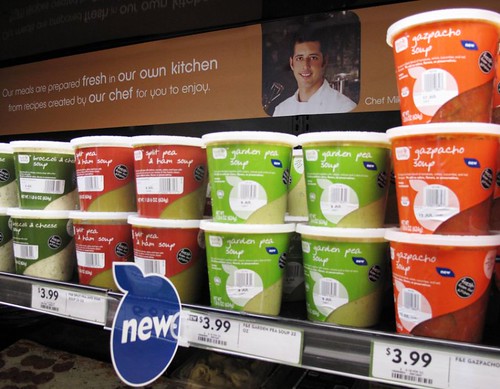
Additionally, designer Cavill's reusable packaging prototype might be a good idea for Tesco's U.S. Fresh & Easy Neighborhood Market fresh food and grocery chain to investigate. For example, Fresh & Easy has a line of refrigerated soups under its 'fresh&easy' private brand. The line, like similar ones (with slight variations on the basic oval container) offered by U.S chains Safeway Stores, Walmart, Kroger Co., Wegmans, Raley's and numerous others, comes in an oval plastic container like this.
Each of the grocers basically borrowed the fresh, refrigerated soup packaging design for its respective private brand from whichever chain came out with it first. Doing so isn't an uncommon practice when it comes to manufacturer or retailer brand food and grocery products. For example, look at how many brands use the same mustard and ketchup squeeze bottles, not to mention the gallon milk jug, and the like.
But innovative packaging, such as Chris Cavill's 'Tesco Sustainable" soup line prototype, which focuses on reusable packaging, also is a point of differentiation for products, including retailer brands. Packaging and the messages it conveys are often the most important aspect of a product's marketing position, in fact.
Further, since being a sustainable grocer is a key part of Tesco's positioning strategy for Fresh & Easy Neighborhood Market, such a product package, focusing on re-use, might be worth investigating by the grocer.


 Posts
Posts